
Discovery through Partnership | Excellence through Quality

Properties
| Storage Buffer | 50mM Tris/HCl, pH 7.5, 150mM NaCl, 10% glycerol |
| Storage Temperature | -20ºC |
| Shipping Temperature | Blue Ice or 4ºC |
| Purification | Affinity Purified |
| Cite This Product | Human Recombinant GRP78 (Bip) Protein (StressMarq Biosciences | Victoria, BC CANADA | Catalog# SPR-107) |
| Certificate of Analysis | This product has been certified >90% pure using SDS-PAGE analysis. The protein shows ATPase activity using a Malachite Green assay. |
Biological Description
| Alternative Names | BiP, GRP78, HSPA5, MIF2, Immunoglobulin heavy chain binding |
| Research Areas | Cancer, Cell Signaling, Chaperones, Heat Shock, Organelle Markers |
| Cellular Localization | Endoplasmic reticulum lumen, Melanosome |
| Accession Number | NM_005347 |
| Gene ID | 3309 |
| Swiss Prot | P11021 |
| Scientific Background |
GRP78, also known as BiP (Binding Immunoglobulin Protein), is a key endoplasmic reticulum (ER) chaperone involved in protein folding, quality control, and the unfolded protein response (UPR). It is a member of the HSP70 family and is upregulated during ER stress to maintain cellular homeostasis. In neuroscience, GRP78 plays a protective role against ER stress-induced apoptosis, a common feature in neurodegenerative diseases such as Alzheimer’s, Parkinson’s, and ALS. Neurons are particularly sensitive to disruptions in protein folding, and GRP78 helps mitigate this by stabilizing misfolded proteins and regulating UPR signaling pathways. Reduced GRP78 expression has been observed in the brains of Alzheimer’s patients, correlating with increased protein aggregation and neuronal loss. Conversely, upregulation of GRP78 has been shown to confer neuroprotection in models of glutamate toxicity and oxidative stress. GRP78 also influences neurodevelopment and synaptic plasticity, making it a critical factor in both disease and normal brain function. Its role in modulating ER stress responses positions it as a potential biomarker and therapeutic target for neurodegenerative and neuroinflammatory disorders. |
| References |
1. Cho S., et al (2007) Mol Cell Biol. 27(1): 368-83. 2. Yang Y., et al. (1998) J Biol Chem. 273: 25552-25555. 3. Luo S., et al (2006) 26(15): 5688-97. 4. Yu Z., et al. (1999) Exp Neurol. 15: 302-314. 5. Koomagi R., et al. (1999) Anticancer Res. 19: 4333-4336. 6. Laquerre S., et al. (1998) J. Virology. 72: 4940-4949. 7. Dong D., et al. (2005) Cancer Res. 65(13): 5785-91. |
Product Images
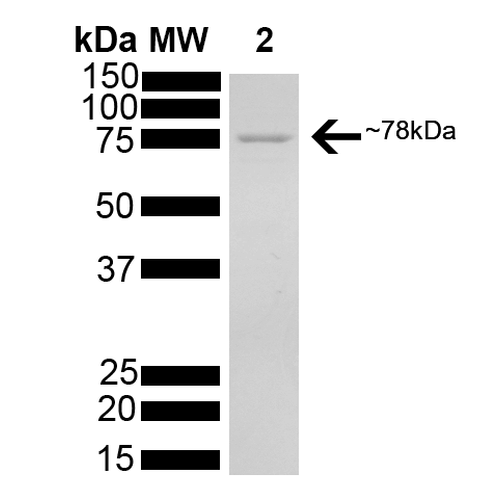
SDS-PAGE of 78kDa Grp78 (Bip) protein (SPR-107).
 Powered by Bioz
StressMarq Biosciences :
Based on validation through cited publications.