
Discovery through Partnership | Excellence through Quality

Properties
| Storage Buffer | 50mM Tris/HCl pH7.5, 5mM Bme, 0.3M NaCl, 10% glycerol |
| Storage Temperature | -20ºC |
| Shipping Temperature | Blue Ice or 4ºC |
| Purification | Affinity Purified |
| Cite This Product | Human Recombinant HSP90 alpha Protein (StressMarq Biosciences | Victoria, BC CANADA | Catalog# SPR-101) |
| Certificate of Analysis | This product has been certified >90% pure using SDSPAGE analysis. |
Biological Description
| Alternative Names | HSP90AA1, HSP90-alpha, HSP90A, HSPCA, HSPC1, Heat shock protein HSP 90-alpha, Heat shock 90 kDa protein 1 alpha isoform, HSPCAL3, HSP86, HSP89A, HSP90Alpha |
| Research Areas | Cancer, Heat Shock |
| Cellular Localization | Cytoplasm, Melanosome |
| Accession Number | AJ890083 |
| Gene ID | 3320 |
| Swiss Prot | P07900 |
| Scientific Background |
HSP90 alpha is a highly conserved molecular chaperone that plays a central role in maintaining protein homeostasis under both normal and stress conditions. In the context of neuroscience, HSP90 alpha is increasingly recognized for its involvement in the folding, stabilization, and functional regulation of key neuronal proteins, including kinases, transcription factors, and hormone receptors. In neurodegenerative diseases such as Alzheimer’s, Parkinson’s, and Huntington’s, the accumulation of misfolded proteins and impaired proteostasis are hallmark features. HSP90 alpha contributes to the cellular defense against these pathologies by stabilizing client proteins and preventing their aggregation. However, its chaperone activity can also inadvertently preserve the function of pathogenic proteins, such as hyperphosphorylated tau or mutant huntingtin, thereby influencing disease progression. HSP90 alpha forms dynamic complexes with co-chaperones like Cdc37 and p23, modulating the fate of its client proteins. Pharmacological inhibition of HSP90 alpha has shown promise in preclinical models by promoting the degradation of neurotoxic proteins and restoring proteostasis. |
| References |
1. Arlander S.J.H., et al. (2003) J Biol Chem. 278: 52572-52577. 2. Pearl H., et al. (2001) Adv Protein Chem. 59:157-186. 3. Neckers L., et al. (2002) Trends Mol Med. 8:S55-S61. 4. Pratt W., Toft D. (2003) Exp Biol Med. 228:111-133. 5. Pratt W., Toft D. (1997) Endocr Rev. 18: 306–360. 6. Pratt W.B. (1998) Proc Soc Exptl Biol Med. 217: 420–434. 7. Whitesell L., et al. (1994) Proc Natl Acad Sci USA. 91: 8324– 8328. |
Product Images
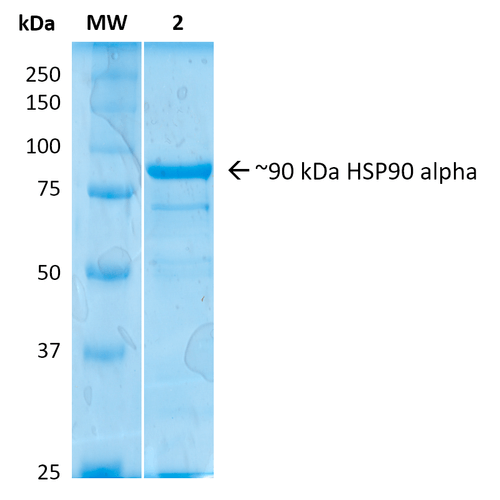
SDS-Page of human HSP90 Alpha protein (SPR-101). Lane 1: Molecular Weight Ladder (MW). Lane 2: Human HSP90 alpha protein (SPR-101).
 Powered by Bioz
StressMarq Biosciences :
Based on validation through cited publications.