
Discovery through Partnership | Excellence through Quality

Properties
| Storage Buffer | PBS pH 7.4 |
| Storage Temperature | -80ºC |
| Shipping Temperature | Dry Ice. Shipping note: Product will be shipped separately from other products purchased in the same order. |
| Purification | Ion-exchange Purified |
| Cite This Product | Cynomolgus Recombinant Alpha Synuclein Monomers: Biotinylated (StressMarq Biosciences | Victoria, BC CANADA | Catalog# SPR-527) |
| Certificate of Analysis | Protein certified > 95% pure via SDS-PAGE and nanodrop analysis. Low endotoxin (< 5 EU/mL) at 2 mg/mL. |
| Other Relevant Information | For corresponding PFF see catalog# SPR-528 (unbiotinylated version not available yet but coming soon) |
Biological Description
| Alternative Names | Alpha-synuclein, α-synuclein, SNCA, Synelfin, NACP, Non-Aβ component of Alzheimer's disease amyloid protein, Non-A beta component precursor, NACP140, PARK1 protein, PARK4 protein, Synuclein alpha, ASYN, Alpha-syn, Macaca fascicularis, UniProt: A0A2K5XN13 |
| Research Areas | Alzheimer's Disease, Neurodegeneration, Neuroscience, Parkinson's Disease, Synuclein, Tangles & Tau, Multiple System Atrophy |
| Swiss Prot | P61142 |
| Scientific Background |
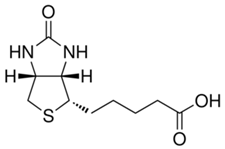
Alpha‑synuclein is a 140‑amino‑acid neuronal protein encoded by the SNCA gene and is highly enriched at presynaptic terminals, where it regulates synaptic vesicle trafficking, neurotransmitter release, and membrane interactions. In neurodegenerative disorders such as Parkinson’s disease, dementia with Lewy bodies, and multiple system atrophy, misfolded alpha‑synuclein adopts aggregation‑prone conformations that progress from soluble monomers to toxic oligomers and fibrils, ultimately forming Lewy body pathology and driving cellular dysfunction and neurodegeneration. Biotinylated alpha‑synuclein monomers provide a powerful, targeted tool for dissecting the earliest molecular events underlying synuclein aggregation. Because monomeric alpha‑synuclein participates directly in membrane binding, vesicle regulation, and aggregation initiation, biotinylated forms enable high‑sensitivity tracking, pulldown assays, protein–protein interaction mapping, and real‑time monitoring of conformational transitions essential to disease progression. These labeled monomers facilitate precise identification of proteins that associate with early aggregation intermediates, advancing mechanistic understanding of how monomeric alpha‑synuclein transitions to pathogenic species. Biotinylated monomers also strengthen translational research by enabling controlled seeding assays, quantification of aggregation kinetics, and high‑resolution characterization of structural changes during oligomer formation. Such approaches help model prion‑like propagation, evaluate therapeutic candidates that target early misfolding, and refine biomarker discovery for synucleinopathies. Their versatility makes biotinylated alpha‑synuclein monomers a critical component of modern neurodegenerative disease research, offering a direct window into the molecular determinants that initiate and accelerate pathological protein aggregation. A 15 amino acid tag on the C-terminal tail of alpha synuclein facilitates site-specific covalent biotinylation. Biotinylation of purified alpha synuclein allows for many biological applications, such as monitoring and detection using streptavidin-based conjugates. StressMarq’s biotinylated monomers are also used to generate pre-formed fibrils in-vitro. |
| References |
1.,Fairhead & Howarth. 2015. Site-specific biotinylation of purified proteins using BirA. Methods in Molecular Biology. DOI: 1007/978-1-4939-2272-7_12 2.,Hallacli et al. 2022. The Parkinson’s disease protein alpha synuclein is a modulator of Processing-bodies and mRNA stability. Cell. DOI: 10.1016/j.cell.2022.05.008 3.,Li et al. 2019. Naturally occurring antibodies isolated from PD patients inhibit synuclein seeding in vitro and recognize Lewy pathology. Acta neuropathologica. DOI: 10.1007/s00401-019-01974-5. |
Product Images
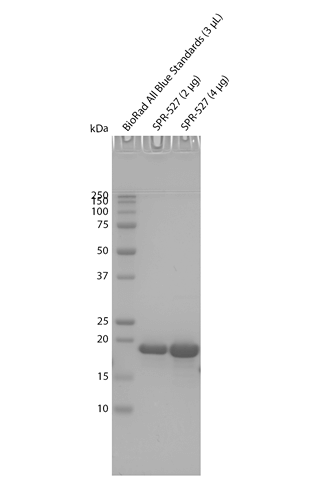
SDS-PAGE analysis of purified Cynomolgus Alpha Synuclein Monomers: Biotinylated (C-Terminus) on a 12% Bis-Tris gel.
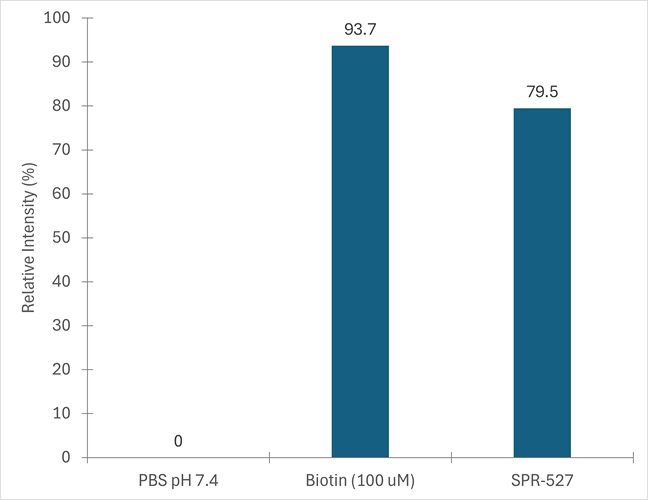
Biotinylation assay on purified Cynomolgus Alpha Synuclein Monomers: Biotinylated (C-Terminus). The assay is performed on 123 uM of monomers post-biotinylation (SPR-527), with 100 uM of biotin as a positive control & PBS pH 7.4 as a negative control. Absorbance is measured at 500nm, and results are converted to % of biotinylation.
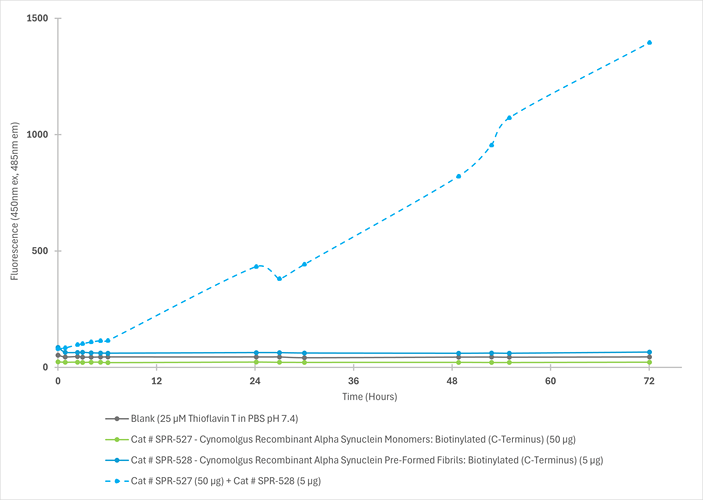
In vitro seeding activity of Cynomolgus Alpha Synuclein Monomers: Biotinylated (C-Terminus) in a Thioflavin T (ThT) assay. Cynomolgus Alpha Synuclein Pre-Formed Fibrils: Biotinylated (C-Terminus) (SPR-528) seed fibril formation of Cynomolgus Alpha Synuclein Monomers: C-Term Biotinylated (SPR-527) over 72 hours. Reactions (100uL) shaken at 600 rpm in Greiner-Bio 96 Well Non-Binding Cell Culture Microplates, Black (Greiner-Bio Catalog #655900) at 37℃ in the presence of 25 uM ThT and read with an XPS Microplate Reader set at 450nmex/485nmem.
 Powered by Bioz
Reviews
There are no reviews yet.