
Discovery through Partnership | Excellence through Quality

Properties
| Storage Buffer | PBS pH 7.4 |
| Storage Temperature | -80ºC |
| Shipping Temperature | Dry Ice. Shipping note: Product will be shipped separately from other products purchased in the same order. |
| Purification | Ion-exchange Purified |
| Cite This Product | Human Recombinant Tau dGAE (297-391) C322A Mutant Monomers (StressMarq Biosciences | Victoria, BC CANADA | Catalog# SPR-445) |
| Certificate of Analysis | Certified >95% pure using SDS-PAGE analysis. |
| Other Relevant Information | For corresponding PFFs, see catalog# SPR-461 |
Biological Description
| Alternative Names | Tau dGAE C322A, Tau 297–391 C322A, Tau fragment 297–391 C322A, Truncated Tau C322A, microtubule-associated tau, MAPT, MAP, Tau-441, Paired Helical Filament-Tau, Phf-Tau, Neurofibrillary Tangle, G Protein Beta1/Gamma2 Subunit-Interacting Factor 1, Isoform 2, tubulin-associated unit, 95-amino acid Tau fragment |
| Research Areas | Alzheimer's Disease, Axon Markers, Cell Markers, Cell Signaling, Cytoskeleton, Microtubules, MT Associated Proteins, Neurodegeneration, Neuron Markers, Neuroscience, Tangles & Tau |
| Cellular Localization | Axolemma, Axolemma Plasma Membrane, Axon, Cell Body, Cell membrane, Cytoplasm, Cytoplasmic Ribonucleoprotein Granule, Cytoplasmic Side, Cytoskeleton, Cytosol, Dendrite, Growth cone, Microtubule, Microtubule Associated Complex, Neurofibrillary Tangle, Neuronal Cell Body, Nuclear Periphery, Nuclear Speck, Nucleus, Peripheral membrane protein, Plasma Membrane, Tubulin Complex |
| Accession Number | NP_005901.2 |
| Gene ID | 4137 |
| Swiss Prot | P10636 |
| Scientific Background |
Tau dGAE (297–391) C322A mutant monomers represent a refined molecular tool for studying tau aggregation in neurodegenerative diseases, particularly Alzheimer’s disease (AD). This engineered variant of the tau protein, derived from the microtubule-binding domain, incorporates a cysteine-to-alanine substitution at position 322, which significantly alters its aggregation behavior. Unlike wild-type tau, the C322A mutant monomers exhibit enhanced stability and a distinct propensity to form filamentous structures that closely resemble the paired helical filaments (PHFs) found in AD brains. These filaments display a more open C-shaped core, offering a structurally relevant model for investigating disease-specific tau conformations. The mutant’s ability to seed further aggregation in vitro underscores its utility in real-time quaking-induced conversion (RT-QuIC) assays and other amplification platforms. Importantly, the C322A mutation reduces disulfide-mediated crosslinking, promoting monomeric stability and controlled filament formation. This facilitates reproducible studies of tau misfolding, aggregation kinetics, and the molecular mechanisms underlying tauopathies. The mutant’s behavior also provides insights into the prion-like propagation of tau pathology and supports the development of targeted therapeutics aimed at halting filament spread. In summary, Tau dGAE C322A mutant monomers serve as a powerful and disease-relevant model for dissecting tau aggregation pathways. Their unique structural and biochemical properties make them indispensable in advancing precision medicine approaches for AD and related tauopathies. |
| References |
1. www.alz.org/alzheimers-dementia/facts-figures 2. Alzheimer, A. Über eine eigenartige Erkrankung der Hirnrinde. Allg. Z. Psychiatr. Psych.-Gerichtl. Med. 64, 146–148 (1907) 3. Al-Hilaly, Y.K. et al. Alzheimer's Disease-like Paired Helical Filament Assembly from Truncated Tau Protein Is Independent of Disulfide Crosslinking. J. Mol. Biol. 429(23):3650-3665 (2017) |
Product Images
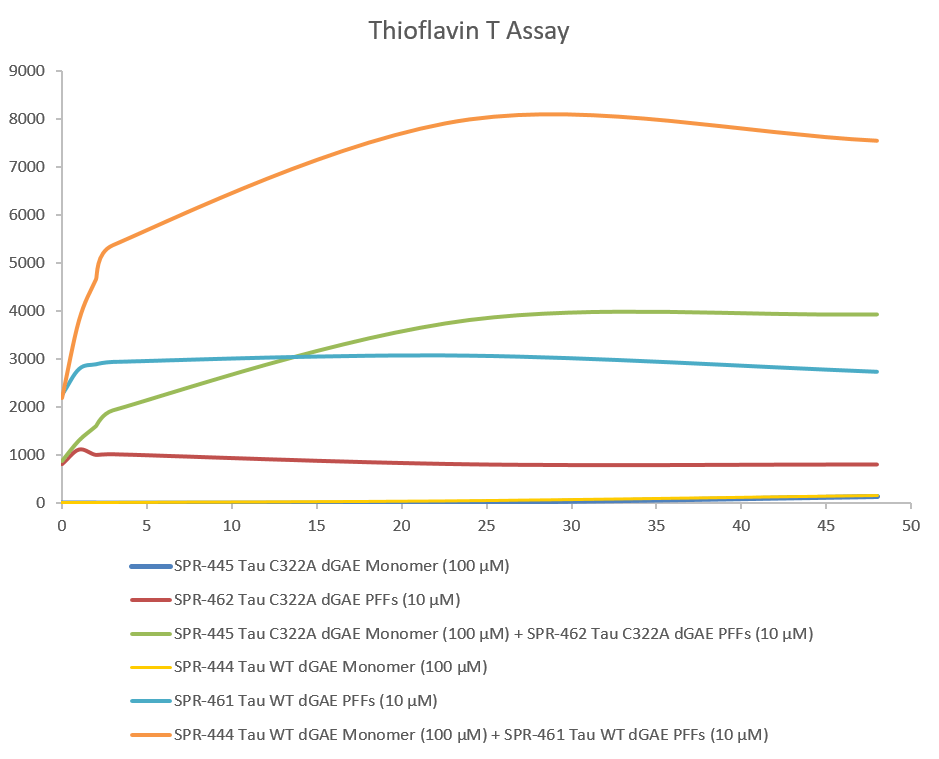
Thioflavin T is a fluorescent dye that binds to beta sheet-rich structures, such as those in tau fibrils. Upon binding, the emission spectrum of the dye experiences a red-shift and increased fluorescence intensity. Thioflavin T emission curves show increased fluorescence (correlated to tau aggregation) over time when truncated tau fragment (AA297-391) (dGAE C322A) monomer is combined with truncated tau fragment (AA297-391) (dGAE C322A) Pre-formed fibrils (Type 1).
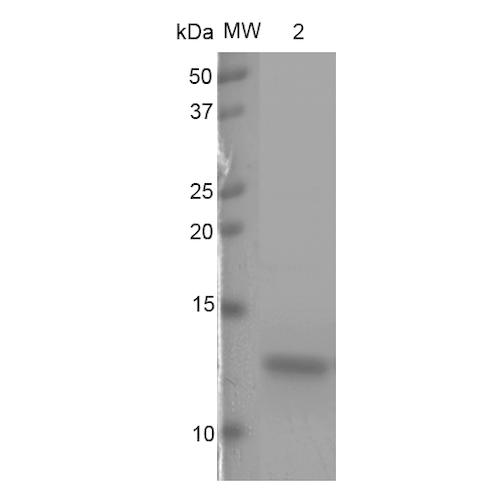
Coomassie gel stain of Human K18 K280 Deletion Tau protein monomer (SPR-445). Load: 2 ug. Lane 1: MW ladder. Lane 2: SPR-445
 Powered by Bioz
Matthew Beckham :
Application: WB
Tissue or cell type and species: N/A
Great for recognizing Human and Mouse antigen, just what it is supposed to do.