
Discovery through Partnership | Excellence through Quality

Properties
| Storage Buffer | PBS pH 7.4 |
| Storage Temperature | -80ºC |
| Shipping Temperature | Dry Ice. Shipping note: Product will be shipped separately from other products purchased in the same order. |
| Purification | Ion-exchange Purified |
| Cite This Product | Human Recombinant Tau-441 (2N4R) P301S Mutant Monomers (StressMarq Biosciences | Victoria, BC CANADA | Catalog# SPR-473) |
| Certificate of Analysis | Certified >95% pure using SDS-PAGE analysis. Low endotoxin <5 EU/mL @ 2mg/mL. |
| Other Relevant Information | SPR-473 is post-translationally modified due to baculovirus/SF9 insect cells expression system. |
Biological Description
| Alternative Names | Tau-441, Tau-F, Tau 441, 2N4R, MAPT, TAU, MTBT1, MTBT2, MAPTL, PPND, PPP1R103, FTDP-17, PHF-Tau, Paired Helical Filament-Tau, Neurofibrillary Tangle, NFTs, intracellular neurofibrillary tangles, Tau aggregates, Tau inclusions, G Protein Beta1/Gamma2 Subunit-Interacting Factor 1 |
| Research Areas | Alzheimer's Disease, Axon Markers, Cell Markers, Cell Signaling, Cytoskeleton, Microtubules, MT Associated Proteins, Neurodegeneration, Neuron Markers, Neuroscience, Tangles & Tau |
| Cellular Localization | Axolemma, Axolemma Plasma Membrane, Axon, Cell Body, Cell membrane, Cytoplasm, Cytoplasmic Ribonucleoprotein Granule, Cytoplasmic Side, Cytoskeleton, Cytosol, Dendrite, Growth cone, Microtubule, Microtubule Associated Complex, Neurofibrillary Tangle, Neuronal Cell Body, Nuclear Periphery, Nuclear Speck, Nucleus, Peripheral membrane protein, Plasma Membrane, Tubulin Complex |
| Accession Number | NP_005901.2 |
| Gene ID | 4137 |
| Swiss Prot | P10636 |
| Scientific Background |
Tau protein, encoded by the MAPT gene (UniProt ID: P10636), is a microtubule-associated protein critical for maintaining neuronal architecture and intracellular transport. The Tau-441 isoform (2N4R), the longest adult brain variant, includes two N-terminal inserts and four microtubule-binding repeats, making it highly relevant in the context of tauopathies. The P301S mutation, located within the microtubule-binding domain, alters Tau’s conformation and increases its tendency to misfold. While aggregated forms such as fibrils are well-known contributors to neurodegeneration, recent research highlights the importance of monomeric P301S Tau in initiating pathological cascades. These monomers exhibit altered biochemical properties, including reduced microtubule binding and increased susceptibility to post-translational modifications, which can prime them for aggregation and toxicity. Tau-441 P301S mutant monomers serve as a critical starting point for in vitro and in vivo studies exploring early-stage Tau dysfunction. Their use enables researchers to dissect the molecular events leading to aggregation, synaptic impairment, and neuronal death. These monomers also provide a baseline for evaluating therapeutic agents aimed at stabilizing native Tau, preventing misfolding, and interrupting disease progression before fibril formation. By modeling the earliest phases of Tau pathology, Tau-441 P301S mutant monomers offer a high-resolution lens into the mechanisms of neurodegenerative disease and support the development of preventative strategies in tauopathy research. |
| References |
1. www.alz.org/alzheimers-dementia/facts-figures 2. Alzheimer, A. Über eine eigenartige Erkrankung der Hirnrinde. Allg. Z. Psychiatr. Psych.-Gerichtl. Med. 64, 146–148 (1907) 3. Matsumoto, G. et al. (2018). Int J Mol Sci. 19, 1497. 4. Goedert, M. and Spillantini, M. G. (2017). Mol Brain. 10:18. 5. Bugiani, O. et al. (1999). J Neuropathol Exp Neurol. 58(6):667-77. |
Product Images
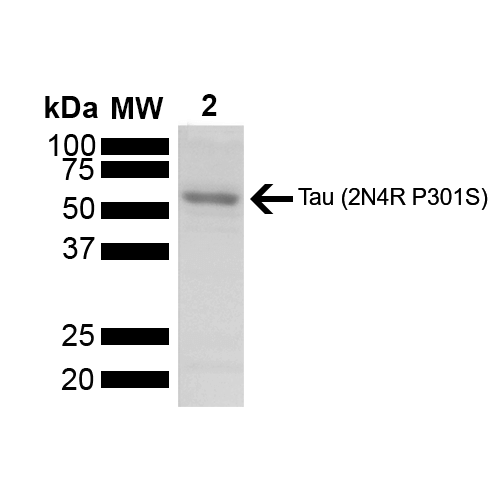
SDS-PAGE of tau protein monomer (SPR-473)
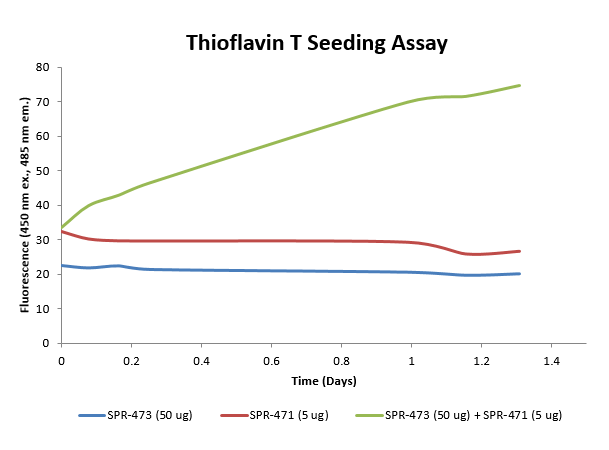
Thioflavin T assay of tau pre-formed fibrils (PFFs) combined with tau monomers. The PFFs seed the aggregation of the monomers
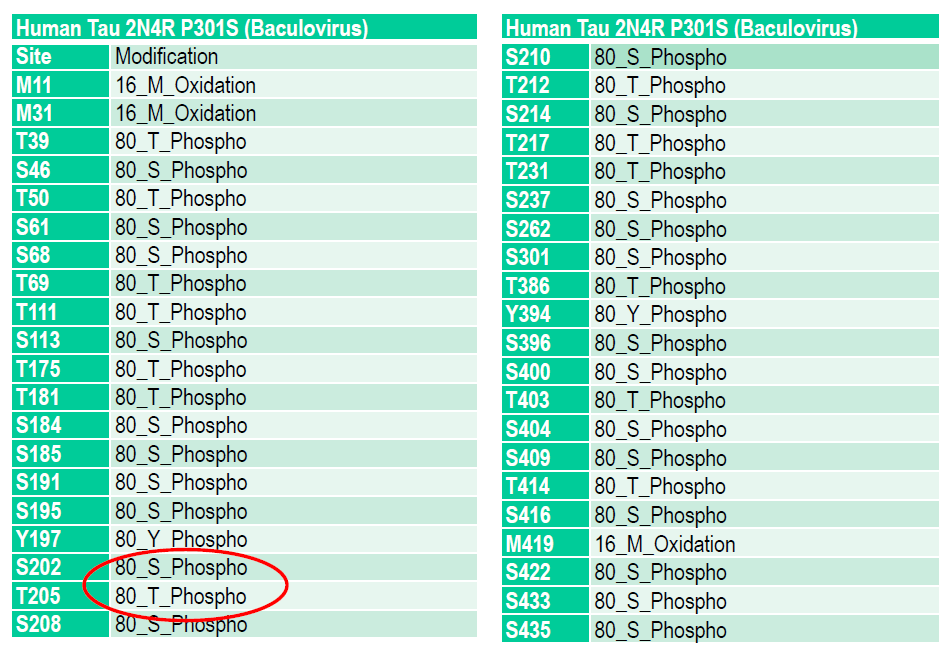
Mass spectrometry analysis of Tau441 (2N4R) P301S mutant monomers (SPR-473) expressed in baculovirus. Mass spectrometry analysis shows phosphorylation at sites including threonine 181, serine 202, and threonine 205.
 Powered by Bioz
Reviews
There are no reviews yet.