
Discovery through Partnership | Excellence through Quality

Properties
| Storage Buffer | 10 mM HEPES, 100 mM NaCl pH 7.4 |
| Storage Temperature | -80ºC |
| Shipping Temperature | Dry Ice. Shipping note: Product will be shipped separately from other products purchased in the same order. |
| Purification | Ion-exchange Purified |
| Cite This Product | Human Recombinant Tau-441 (2N4R) Wild-Type Monomers (StressMarq Biosciences | Victoria, BC CANADA | Catalog# SPR-479) |
| Certificate of Analysis | Certified >95% pure using SDS-PAGE analysis. Low endotoxin <5 EU/mL @ 2mg/mL. |
| Other Relevant Information | For corresponding PFFs, see catalog# SPR-480 |
Biological Description
| Alternative Names | MAPT, Tau, Tau-441, 2N4R, Tau40, intracellular neurofibrillary tangles, NFTs, paired helical filaments, PHFs, microtubule-associated Tau, tubulin-associated unit, Paired Helical Filament-Tau, Phf-Tau, G Protein Beta1/Gamma2 Subunit-Interacting Factor 1, Isoform 2 |
| Research Areas | Alzheimer's Disease, Axon Markers, Cell Markers, Cell Signaling, Cytoskeleton, Microtubules, MT Associated Proteins, Neurodegeneration, Neuron Markers, Neuroscience, Tangles & Tau |
| Cellular Localization | Axolemma, Axolemma Plasma Membrane, Axon, Cell Body, Cell membrane, Cytoplasm, Cytoplasmic Ribonucleoprotein Granule, Cytoplasmic Side, Cytoskeleton, Cytosol, Dendrite, Growth cone, Microtubule, Microtubule Associated Complex, Neurofibrillary Tangle, Neuronal Cell Body, Nuclear Periphery, Nuclear Speck, Nucleus, Peripheral membrane protein, Plasma Membrane, Tubulin Complex |
| Gene ID | 4137 |
| Swiss Prot | P10636 |
| Scientific Background |
Tau protein, encoded by the MAPT gene (UniProt ID: P10636), is a microtubule-associated protein essential for stabilizing neuronal microtubules and maintaining axonal transport. The Tau-441 isoform (2N4R), the longest variant expressed in the adult human brain, contains two N-terminal inserts and four microtubule-binding repeats, making it a key reference in tauopathy research. In its wild-type monomeric form, Tau-441 exhibits native folding and functional microtubule-binding capacity. This form serves as a critical baseline for understanding how mutations, post-translational modifications, and environmental stressors disrupt Tau’s structure and function, leading to pathological aggregation. Studying wild-type monomers allows researchers to pinpoint the earliest molecular events that precede fibril formation and neurodegeneration. Tau-441 wild-type monomers are widely used in biochemical, structural, and cellular assays to investigate Tau’s physiological roles and its transition into disease-associated conformers. These studies inform the development of therapeutic strategies aimed at preserving Tau’s native state, preventing misfolding, and maintaining neuronal health. As a foundational model, Tau-441 wild-type monomers provide essential insights into Tau biology and offer a reference framework for evaluating the impact of disease-linked variants in neurodegenerative research. |
| References |
1. www.alz.org/alzheimers-dementia/facts-figures 2. Alzheimer, A. Über eine eigenartige Erkrankung der Hirnrinde. Allg. Z. Psychiatr. Psych.-Gerichtl. Med. 64, 146–148 (1907) 3. Matsumoto, G. et al. (2018). Int J Mol Sci. 19, 1497. 4.Von Bergen, M. et al. (2001). J Biol Chem. 276(51):48165-48174. 5. Guo, J. and Lee, M.Y. (2013). FEBS Lett. 587(6): 717-723. |
Product Images
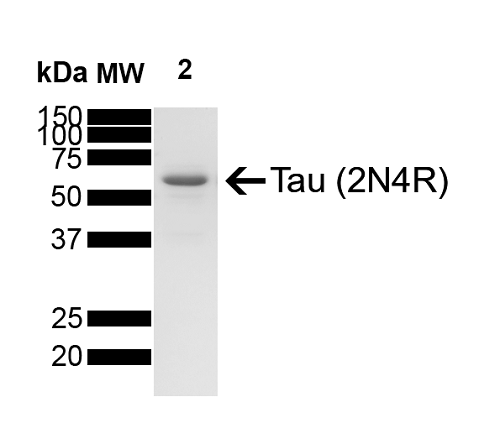
SDS-PAGE of Wild-Type Tau monomers (SPR-479)
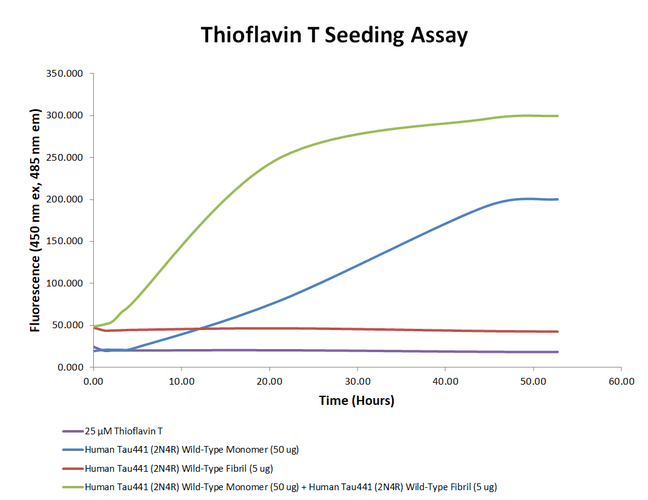
Thioflavin T is a fluorescent dye that binds to beta sheet-rich structures, such as those in tau fibrils. Upon binding, the emission spectrum of the dye experiences a red-shift and increased fluorescence intensity. Thioflavin T emission curves show increased fluorescence (correlated to tau aggregation) over time when tau wild-type monomers (SPR-479) are combined with tau wild-type fibrils (SPR-480).
 Powered by Bioz
StressMarq Biosciences :
Based on validation through cited publications.