
Discovery through Partnership | Excellence through Quality

Properties
| Storage Buffer | 10 mM Hepes pH 7.4, 100 mM NaCl |
| Storage Temperature | -80ºC |
| Shipping Temperature | Dry Ice. Shipping note: Product will be shipped separately from other products purchased in the same order. |
| Purification | Ion-exchange Purified |
| Cite This Product | Human Recombinant Tau-352 (fetal 0N3R) Wild-Type Monomers (StressMarq Biosciences | Victoria, BC CANADA | Catalog# SPR-490) |
| Certificate of Analysis | Protein certified >95% pure on SDS-PAGE & Nanodrop analysis. Low endotoxin <5 EU/mL @ 2mg/mL. |
| Other Relevant Information | For corresponding PFFs, see catalog# SPR-491 |
Biological Description
| Alternative Names | Tau, Tau aggregate, microtubule-associated Tau, MAPT, MAP, microtubule-associated, Paired Helical Filament-Tau, Phf-Tau, Neurofibrillary Tangle, G Protein Beta1/Gamma2 Subunit-Interacting Factor 1, Isoform 2, tubulin-associated unit, 95-amino acid Tau fragment, Truncated Tau, Tau-352, 0N3R Tau, fetal Tau |
| Research Areas | Alzheimer's Disease, Axon Markers, Cell Markers, Cell Signaling, Cytoskeleton, Microtubules, MT Associated Proteins, Neurodegeneration, Neuron Markers, Neuroscience, Tangles & Tau |
| Cellular Localization | Axolemma, Axolemma Plasma Membrane, Axon, Cell Body, Cell membrane, Cytoplasm, Cytoplasmic Ribonucleoprotein Granule, Cytoplasmic Side, Cytoskeleton, Cytosol, Dendrite, Growth cone, Microtubule, Microtubule Associated Complex, Neurofibrillary Tangle, Neuronal Cell Body, Nuclear Periphery, Nuclear Speck, Nucleus, Peripheral membrane protein, Plasma Membrane, Tubulin Complex |
| Accession Number | NP_058525.1 |
| Gene ID | 4137 |
| Swiss Prot | P10636-2 |
| Scientific Background |
Tau protein, encoded by the MAPT gene (UniProt ID: P10636), is a microtubule-associated protein essential for neuronal stability and axonal transport. The Tau-352 isoform, also known as 0N3R, is a fetal variant composed of three microtubule-binding repeats and lacking N-terminal inserts. This isoform is predominantly expressed during early brain development and is gradually replaced by adult isoforms postnatally. In neurodegenerative disease research, Tau-352 wild-type monomers serve as a critical model for understanding isoform-specific contributions to tauopathies. Although considered less aggregation-prone than longer adult isoforms, 0N3R Tau can still misfold under pathological conditions, initiating early aggregation events that may contribute to disease onset. Its unique structural and functional properties offer insights into how developmental Tau variants influence susceptibility to neurodegeneration. Tau-352 monomers are used in biochemical and cellular assays to study microtubule interactions, phosphorylation dynamics, and conformational changes that precede fibril formation. Their relevance extends to conditions such as Alzheimer’s disease and Pick’s disease, where altered isoform ratios and post-translational modifications are implicated in disease progression. By modeling the behavior of fetal Tau in both healthy and pathological contexts, Tau-352 wild-type monomers provide a foundational platform for exploring early mechanisms of Tau dysfunction and identifying therapeutic strategies aimed at preserving neuronal integrity. |
| References |
1. www.alz.org/alzheimers-dementia/facts-figures. 2. Goedert et al. Multiple isoforms of human microtubule-associated protein tau: Sequences and localization in neurofibrilary tangles of Alzheimer’s disease. Neuron. 1989;3(4):519-526. 3. Shahpasand-Kroner et al. Three-repeat and four-repeat tau isoforms for different oligomers. Prot. Sci. 2021;doi: 10.1002/pro4257. 4. Dregni, et al. Inclusion of the C‑Terminal Domain in the β‑Sheet Core of Heparin-Fibrillized Three-Repeat Tau Protein Revealed by Solid-State Nuclear Magnetic Resonance Spectroscopy. JACS. 2021. https://doi.org/10.1021/jacs.1c03314. |
Product Images
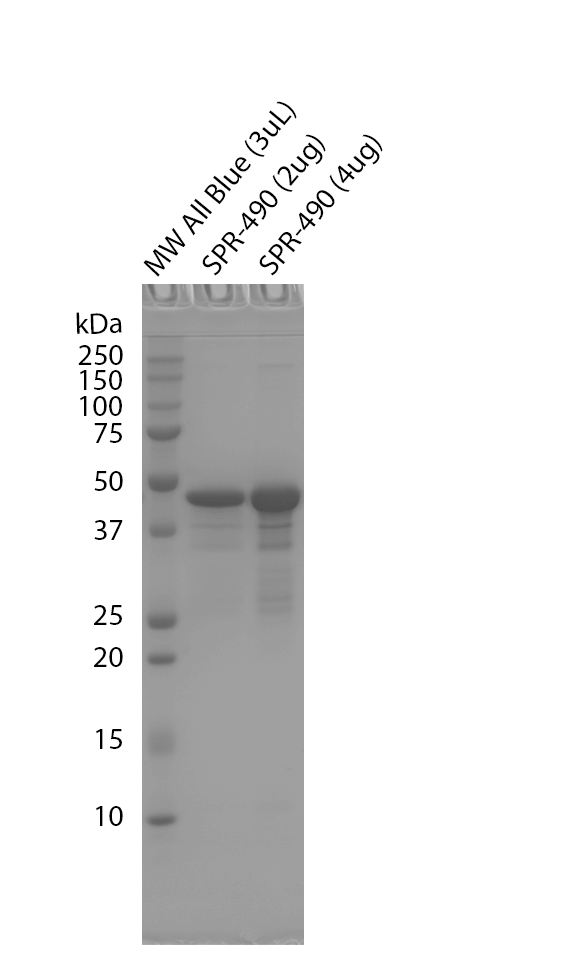
Tris-glycine SDS-PAGE (12%) of Fetal Tau 0N3R monomers. MW ladder = Precision Plus Protein All Blue pre-stained standards.
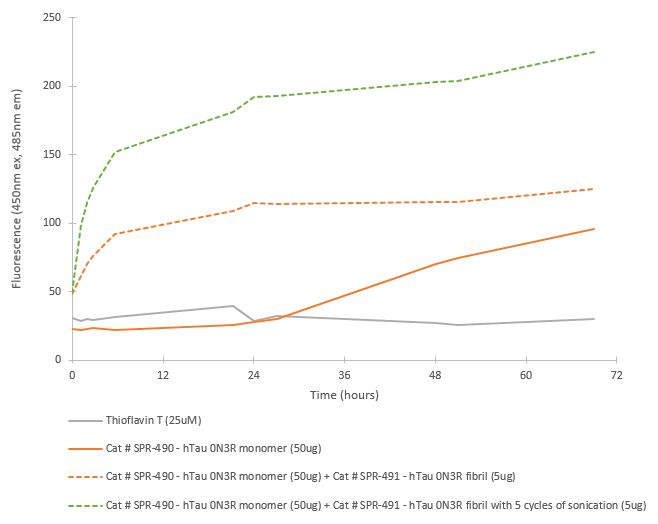
Fibril formation activity of Fetal Tau 0N3R monomers in ThT seeding assay. Monomers readily form fibrils upon the addition of heparin or when seeded by 0N3R pre-formed fibrils. DTT was added to each well to control disulfide bonding during fibril formation.
 Powered by Bioz
Reviews
There are no reviews yet.