
Discovery through Partnership | Excellence through Quality

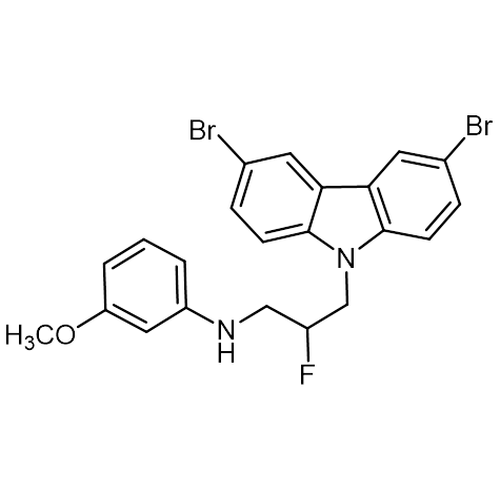
| Product Name | P7C3-A20 |
| Description |
Neuroprotective Agent |
| Purity | ≥98% (HPLC); NMR (Conforms) |
| CAS No. | 1235481-90-9, |
| Molecular Formula | C22H19Br2FN2O |
| Molecular Weight | 506.2 |
| Field of Use | Not for use in humans. Not for use in diagnostics or therapeutics. For in vitro research use only. |
Properties
| Storage Temperature | -20ºC |
| Shipping Temperature | Shipped Ambient |
| Product Type | Neuroprotective |
| Solubility | May be dissolved in DMSO (40 mg/ml) |
| Source | Synthetic |
| Appearance | Off-white powder |
| SMILES | COC1=CC=CC(=C1)NCC(CN2C3=C(C=C(C=C3)Br)C4=C2C=CC(=C4)Br)F |
| InChI | InChI=1S/C22H19Br2FN2O/c1-28-18-4-2-3-17(11-18)26-12-16(25)13-27-21-7-5-14(23)9-19(21)20-10-15(24)6-8-22(20)27/h2-11,16,26H,12-13H2,1H3 |
| InChIKey | XNLTWMQBJFWQOU-UHFFFAOYSA-N |
| Safety Phrases | Classification: No data available |
| Cite This Product | P7C3-A20 (StressMarq Biosciences | Victoria, BC CANADA | Catalog# SIH-639) |
Biological Description
| Alternative Names | 3,6-Dibromo--fluoro-N-(3-methoxyphenyl)-9H-carbazole-9-propanamine |
| Research Areas | Alzheimer's Disease, Neurodegeneration, Neuroscience |
| PubChem ID | 46853447 |
| Scientific Background | P7C3‑A20 is a neuroprotective and pro‑neurogenic small molecule that acts through stimulation of NAMPT, a key enzyme in neuronal NAD⁺ biosynthesis¹. This compound enhances neuronal survival and promotes endogenous repair mechanisms following traumatic brain injury (TBI)². In mouse models of chronic TBI, P7C3‑A20 also repairs blood–brain barrier integrity, halts progressive neurodegeneration by reversing tau phorphorylation³, and restores cognitive function⁴. Beyond TBI, it demonstrates robust neuroprotective activity in models of hypoxic–ischemic encephalopathy⁵. Additionally, P7C3‑A20 suppresses neuroinflammation and protects retinal ganglion cells from degeneration in a rat optic nerve crush model(6), highlighting its potential across multiple forms of CNS injury. |
| References |
1. PM LoCoco et al., eLife (2017) 6:e29626 2. MO Blaya et al., J. Neurotrauma (2014) 31:476 3. Chaubey et al. Cell Reports Medicine (2026) 7(1): https://www.cell.com/cell-reports-medicine/fulltext/S2666-3791(25)00608-1 4. E Vazquez‑Rosa et al., Proc. Natl. Acad. Sci. USA (2020) 117:27667 J Bai et al., Neuroscience (2020) 441:197 5. J Bai et al., Neuroscience (2020) 441:197 6. H Oku et al., Invest. Ophthalmol. Vis. Sci. (2017) 58:4877 |
Product Images
 Powered by Bioz
Reviews
There are no reviews yet.