
Advancing the Frontiers of Neurodegenerative Disease Research

Properties
| Storage Buffer | PBS pH 7.4 |
| Storage Temperature | -80ºC |
| Shipping Temperature | Dry Ice. Shipping note: Product will be shipped separately from other products purchased in the same order. |
| Purification | Ion-exchange Purified |
| Cite This Product | Human Recombinant Alpha Synuclein G51D Mutant Monomers, catalog# SPR-540 (StressMarq Biosciences, Victoria BC CANADA) |
| Certificate of Analysis | Protein certified > 95% pure via SDS-PAGE and A260/A280 ratio |
| Other Relevant Information | For corresponding pre-formed fibrils (PFFs), see Catalog # SPR-541. |
Biological Description
| Alternative Names | G51D α-synuclein, Alpha-synuclein G51D, α-Synuclein G51D, α-Synuclein p.Gly51Asp, α-Synuclein Gly51Asp, Human alpha-synuclein G51D, G51D mutant alpha-synuclein, SNCA Gly51Asp, G51D α-synuclein monomer, Alpha-synuclein G51D monomer, Monomeric G51D α-synuclein, G51D mutant α-synuclein monomer, Recombinant G51D α-synuclein monomer |
| Research Areas | Alzheimer's Disease, Neurodegeneration, Neuroscience, Parkinson's Disease, Synuclein, Tangles & Tau, Multiple System Atrophy |
| Swiss Prot | P37840 |
| Scientific Background | The G51D mutation in SNCA, which substitutes aspartic acid for glycine at residue 51 of alpha-synuclein, is associated with an early-onset neurodegenerative syndrome that combines clinical and neuropathological features of Parkinson’s disease (PD) and multiple system atrophy (MSA). G51D-associated disease is characterized by widespread neuronal alpha-synuclein pathology together with oligodendroglial inclusions resembling those observed in MSA. Cryo-electron microscopy further demonstrated that alpha synuclein with the G51D mutation forms a structurally distinct fibril strain capable of cross-seeding wild-type alpha-synuclein, supporting a role for conformational strain selection and templated propagation in disease. Consistent with this strain model, patient-derived G51D aggregates produced a restricted, slowly propagating synucleinopathy in transgenic mice and displayed biochemical and seeding properties distinct from MSA-derived aggregates. StressMarq’s Human Recombinant Alpha Synuclein G51D Mutant Monomers have been demonstrated to form fibrils that do not bind Thioflavin T as readily as ones formed using wild-type monomers. |
| References |
1. Kiely, A. P., Ling, H., Asi, Y. T., Kara, E., Proukakis, C., Schapira, A. H., Morris, H. R., Roberts, H. C., Lubbe, S., Limousin, P., Lewis, P. A., Lees, A. J., Quinn, N., Hardy, J., Love, S., Revesz, T., Houlden, H., & Holton, J. L. (2015). Distinct clinical and neuropathological features of G51D SNCA mutation cases compared with SNCA duplication and H50Q mutation. Molecular Neurodegeneration, 10, Article 41. https://doi.org/10.1186/s13024-015-0038-3 2. Lau, H. H. C., Martinez-Valbuena, I., So, R. W. L., Mehra, S., Silver, N. R. G., Mao, A., Stuart, E., Schmitt-Ulms, C., Hyman, B. T., Ingelsson, M., Kovacs, G. G., & Watts, J. C. (2023). The G51D SNCA mutation generates a slowly progressive α-synuclein strain in early-onset Parkinson’s disease. Acta Neuropathologica Communications, 11, Article 72. https://doi.org/10.1186/s40478-023-01570-5 3. Sun, Y., Long, H., Xia, W., Wang, K., Zhang, X., Sun, B., Cao, Q., Zhang, Y., Dai, B., Li, D., & Liu, C. (2021). The hereditary mutation G51D unlocks a distinct fibril strain transmissible to wild-type α-synuclein. Nature Communications, 12, Article 6252. https://doi.org/10.1038/s41467-021-26433-2 4. Xu, C. K., Castellana-Cruz, M., Chen, S. W., Du, Z., Meisl, G., Levin, A., Mannini, B., Itzhaki, L. S., Knowles, T. P. J., Dobson, C. M., Cremades, N., & Kumita, J. R. (2022). The pathological G51D mutation in alpha-synuclein oligomers confers distinct structural attributes and cellular toxicity. Molecules, 27(4), Article 1293. https://doi.org/10.3390/molecules27041293 |
Product Images
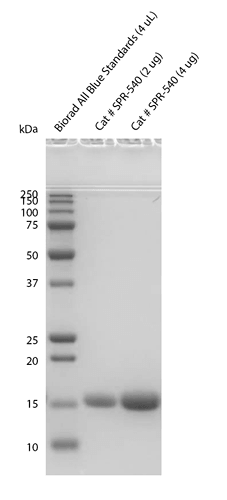
SDS-PAGE analysis of purified Alpha Synuclein G51D Mutant Monomers on a 12% Bis-Tris gel.
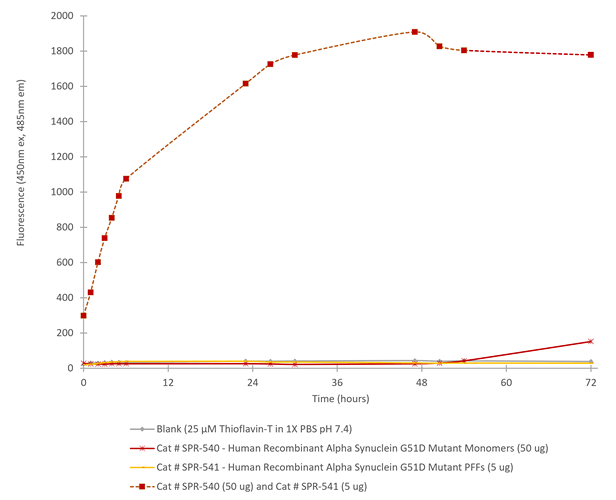
In vitro seeding activity of Alpha Synuclein G51D Mutant Monomers in a Thioflavin T (ThT) assay. Alpha Synuclein G51D Mutant PFFs (Cat# SPR-541) seed fibril formation of Alpha Synuclein G51D Mutant Monomers (Cat# SPR-540) over 72 hours. Reactions (100uL) shaken at 600 rpm in Greiner-Bio 96 Well Non-Binding Cell Culture Microplates, Black (Greiner-Bio Catalog #655900) at 37oC in the presence of 25 uM ThT and read with an XPS Microplate Reader set at 450nmex/485nmem.
 Powered by Bioz
Reviews
There are no reviews yet.