
Advancing the Frontiers of Neurodegenerative Disease Research

| Product Name | Alpha Synuclein Pre-formed Fibrils | |||||||||||||||||||||||||||||||||||||||||||||||||||||||||||||||||||||||||||||||||
| Description |
Human Recombinant Alpha Synuclein PFFs (Type 2) |
|||||||||||||||||||||||||||||||||||||||||||||||||||||||||||||||||||||||||||||||||
| Applications | WB, SDS-PAGE, In vivo assay, In vitro assay | |||||||||||||||||||||||||||||||||||||||||||||||||||||||||||||||||||||||||||||||||
| Concentration | 2 mg/ml or 5 mg/ml | |||||||||||||||||||||||||||||||||||||||||||||||||||||||||||||||||||||||||||||||||
| Conjugates |
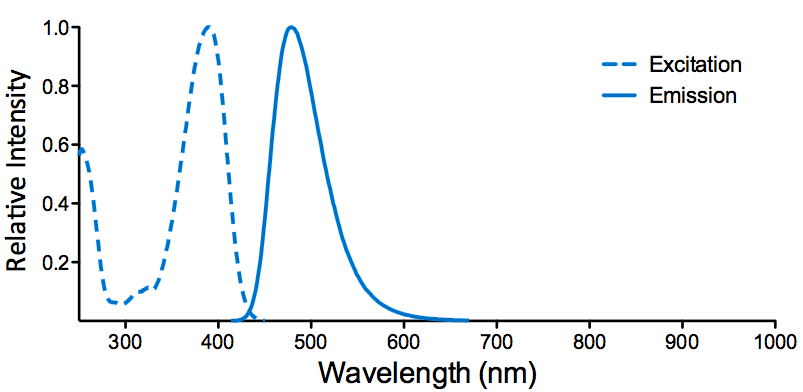
No tag
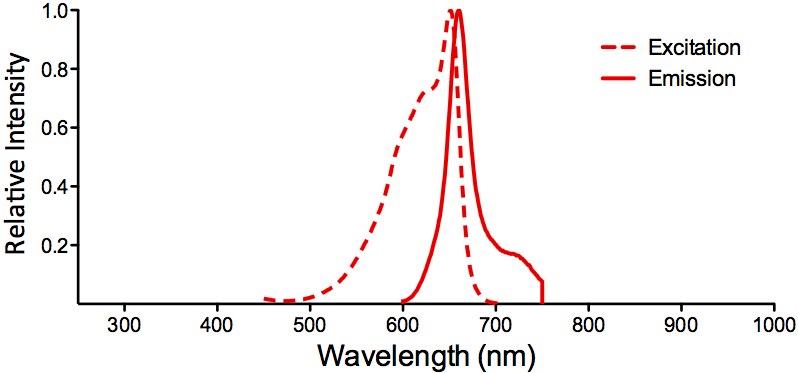
StreptavidinProperties:
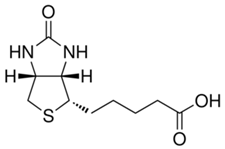
Biotin
|
|||||||||||||||||||||||||||||||||||||||||||||||||||||||||||||||||||||||||||||||||
| Nature | Recombinant | |||||||||||||||||||||||||||||||||||||||||||||||||||||||||||||||||||||||||||||||||
| Species | Human | |||||||||||||||||||||||||||||||||||||||||||||||||||||||||||||||||||||||||||||||||
| Expression System | E. coli | |||||||||||||||||||||||||||||||||||||||||||||||||||||||||||||||||||||||||||||||||
| Amino Acid Sequence | MMDVFMKGLSK AKEGVVAAAE KTKQGVAEAA GKTKEGVLYV GSKTKEGVVH GVATVAEKTK EQVTNVGGAV VTGVTAVAQK TVEGAGSIAA ATGFVKKDQL GKNEEGAPQE GILEDMPVDP DNEAYEMPSE EGYQDYEPEA | |||||||||||||||||||||||||||||||||||||||||||||||||||||||||||||||||||||||||||||||||
| Purity | >95% | |||||||||||||||||||||||||||||||||||||||||||||||||||||||||||||||||||||||||||||||||
| Other Resources | Sonication Protocol | |||||||||||||||||||||||||||||||||||||||||||||||||||||||||||||||||||||||||||||||||
| Protein Length | Full Length | |||||||||||||||||||||||||||||||||||||||||||||||||||||||||||||||||||||||||||||||||
| Protein Size | ~14.46 kDa | |||||||||||||||||||||||||||||||||||||||||||||||||||||||||||||||||||||||||||||||||
| Biological Activity | Does not induce Lewy body inclusion formation in Sprague-Dawley rat primary hippocampal neurons. Thioflavin T emission curve shows only a small increase in fluorescence (indicative of alpha synuclein aggregation) when Type 2 alpha synuclein PFFs (SPR-317) are combined with alpha synuclein monomers (SPR-321 or SPR-316). Certain biological activities in other neuronal cells cannot be ruled out. Researchers should test compatibility prior to use. | |||||||||||||||||||||||||||||||||||||||||||||||||||||||||||||||||||||||||||||||||
| Field of Use | Not for use in humans. Not for use in diagnostics or therapeutics. For in vitro research use only. | |||||||||||||||||||||||||||||||||||||||||||||||||||||||||||||||||||||||||||||||||
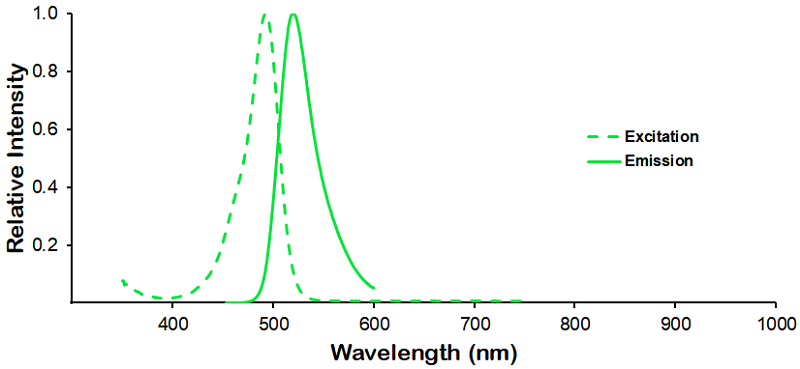
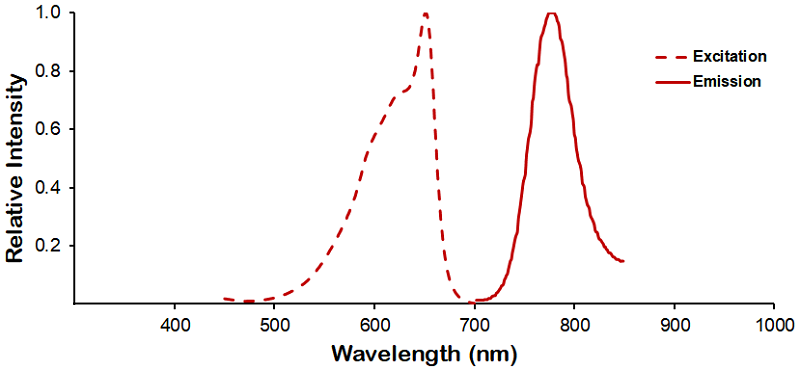
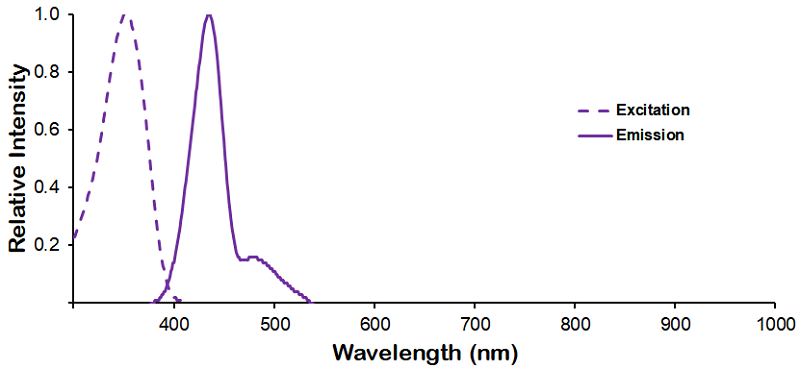
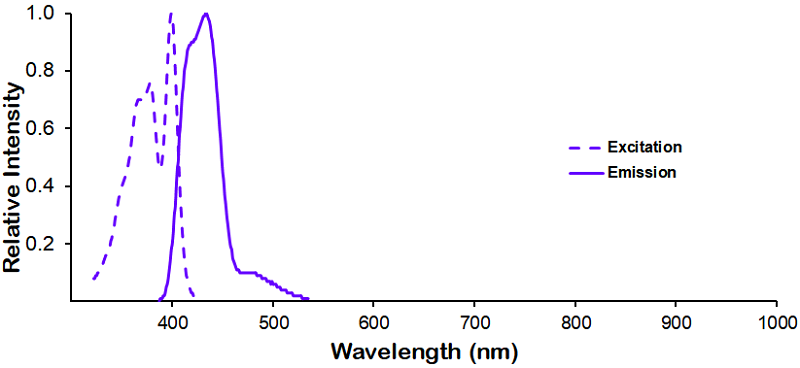
Properties
| Storage Buffer | PBS pH 7.4 |
| Storage Temperature | -80ºC |
| Shipping Temperature | Dry Ice. Shipping note: Product will be shipped separately from other products purchased in the same order. |
| Purification | Ion-exchange Purified |
| Cite This Product | Human Recombinant Alpha Synuclein Pre-formed Fibrils (StressMarq Biosciences | Victoria, BC CANADA | Catalog# SPR-317) |
| Certificate of Analysis | Certified 95% pure using SDS-PAGE analysis. Made with low endotoxin monomer. |
| Other Relevant Information | For best results, sonicate immediately prior to use. Refer to the Neurodegenerative Protein Handling Instructions on our website, or the product datasheet for further information. Monomer source is catalog# SPR-316. |
Biological Description
| Alternative Names | Alpha-synuclein, Alpha synuclein, Asyn, SNCA, NACP, PARK1, PARK4, PD1, Synuclein alpha, Non-A beta component of AD amyloid, Non-A4 component of amyloid precursor, Synuclein Alpha-140, SYN, Parkinson's disease familial 1 Protein Protein, Alpha Synuclein PFFs |
| Research Areas | Alzheimer's Disease, Neurodegeneration, Neuroscience, Parkinson's Disease, Synuclein, Tangles & Tau, Multiple System Atrophy |
| Cellular Localization | Cytoplasm, Membrane, Nucleus |
| Accession Number | NP_000336.1 |
| Gene ID | 6622 |
| Swiss Prot | P37840 |
| Scientific Background |
Alpha-synuclein (α-syn), a neuronal protein encoded by the SNCA gene, is central to the pathology of synucleinopathies, including Parkinson’s disease (PD), Lewy body dementia (LBD), and multiple system atrophy (MSA). While native α-syn exists primarily as a soluble monomer or tetramer, its misfolded forms can aggregate into pre-formed fibrils (PFFs), which act as potent seeds for pathological propagation. PFFs mimic the structural characteristics of disease-associated α-syn aggregates found in Lewy bodies and Lewy neurites. When introduced into neural tissue, PFFs initiate a prion-like cascade, converting endogenous α-syn into insoluble fibrils. This process disrupts synaptic function, induces neuroinflammation, and leads to progressive dopaminergic neuron loss—hallmarks of PD and related disorders. Experimental models using PFF injections have demonstrated accelerated α-syn spreading, cognitive deficits, and transcriptomic changes linked to neurodegeneration. Notably, PFFs trigger alterations in TGFβ signaling, glutamate receptor phosphorylation, and immune activation, revealing molecular pathways that connect α-syn aggregation to dementia. Understanding the mechanisms by which α-syn PFFs drive neurodegeneration is critical for developing targeted therapies. Strategies aimed at inhibiting fibril formation, blocking intercellular transmission, or enhancing clearance of pathological α-syn hold promise for disease modification. As research advances, α-syn PFFs remain a powerful tool for modeling disease and identifying therapeutic targets in synucleinopathies. |
| References |
1. “Genetics Home Reference: SNCA”. US National Library of Medicine. (2013). 2. Zhang L., et al. (2008) Brain Res. 1244: 40-52. 3. Alim M.A., et al. (2002) J Biol Chem. 277(3): 2112-2117. 4. Kokhan V.S., Afanasyeva M.A., Van'kin G. (2012) Behav. Brain. Res. 231(1): 226-230. 5. Spillantini M.G., et al. (1997) Nature. 388(6645): 839-840. 6. Mezey E., et al. (1998) Nat Med. 4(7): 755-757. |
Product Images
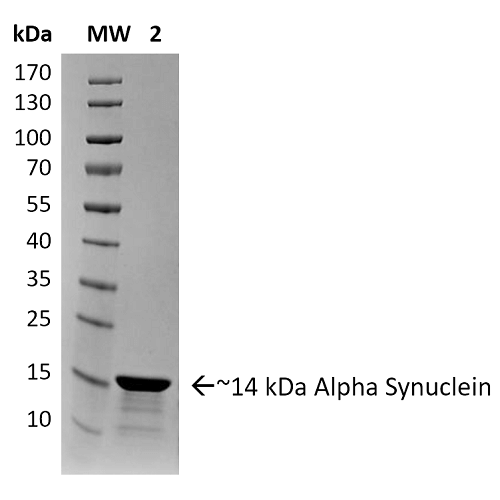
SDS-PAGE of ~14 kDa Human Recombinant Alpha Synuclein Protein Pre-formed Fibrils (Type 2) (SPR-317). Lane 1: Molecular Weight Ladder (MW). Lane 2: Alpha Synuclein Protein Pre-formed Fibrils (SPR-317).
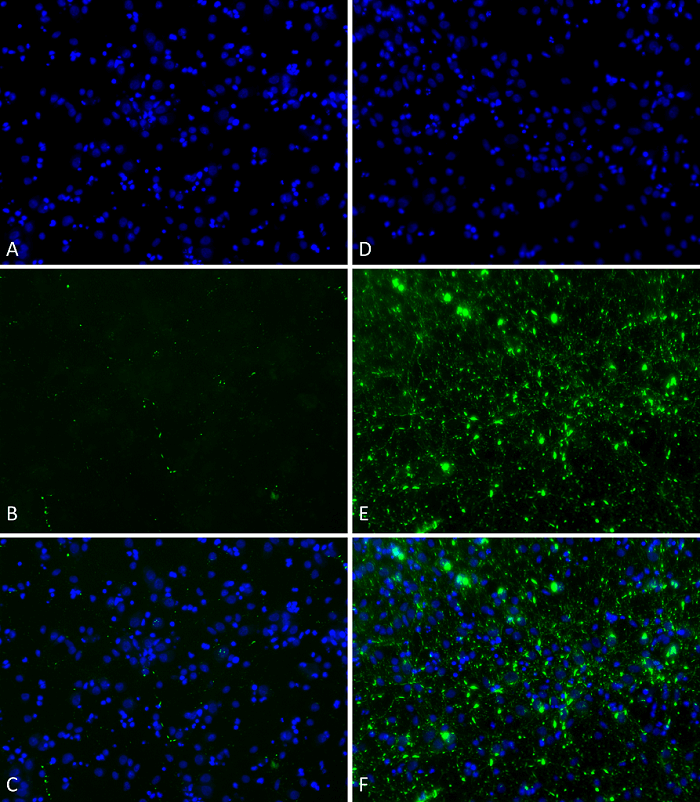
Primary rat hippocampal neurons show lewy body inclusion formation when treated with Type 1 Alpha Synuclein Pre-formed Fibrils (SPR-322) at 4 µg/ml (D-F), but not when treated with Type 2 Alpha Synuclein Pre-formed Fibrils (SPR-317) at 4 µg/ml (A-C). Tissue: Primary hippocampal neurons. Species: Sprague-Dawley rat. Fixation: 4% formaldehyde made from PFA. Primary Antibody: Mouse anti-pSer129 Antibody at 1:1000 24 hours at 4°C; Secondary Antibody: FITC Goat Anti-Mouse (green) at 1:700 for 1 hours at RT (B, E). Counterstain: Hoechst (blue) nuclear stain at 1:4000 for 1 hour at RT (A,D). Localization: Lewy body inclusions. Magnification: 20x. C is A and B merged and F is D and E merged.
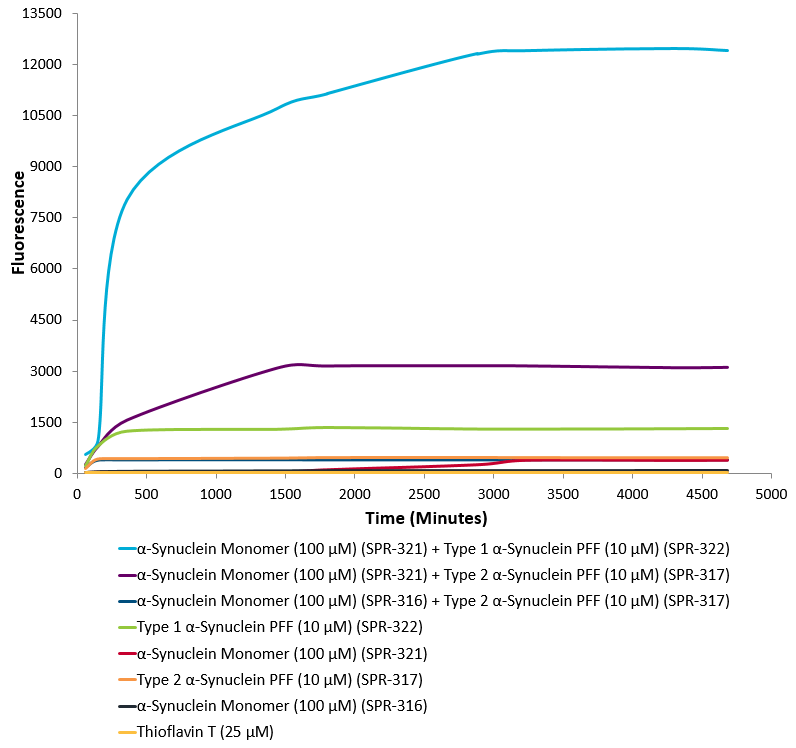
Type 1 alpha synuclein Pre-formed Fibrils (SPR-322) seed the formation of new alpha synuclein fibrils from the pool of alpha synuclein monomers (SPR-321). Thioflavin T is a fluorescent dye that binds to beta sheet-rich structures, such as those in alpha synuclein fibrils. Upon binding, the emission spectrum of the dye experiences a red-shift and increased fluorescence intensity. Thioflavin T emission curves show increased fluorescence (correlated to alpha synuclein protein aggregation) over time when 10 µM of Type 1 alpha synuclein Pre-formed Fibrils (SPR-322) is combined with 100 µM of alpha synuclein monomer (SPR-321), as compared to when 10 µM of Type 2 alpha synuclein Pre-formed Fibrils (SPR-317) is combined with 100 µM of alpha synuclein monomer (SPR-321) or 100 µM of alpha Synuclein monomer (SPR-316). Thioflavin T ex = 450 nm, em = 485 nm.
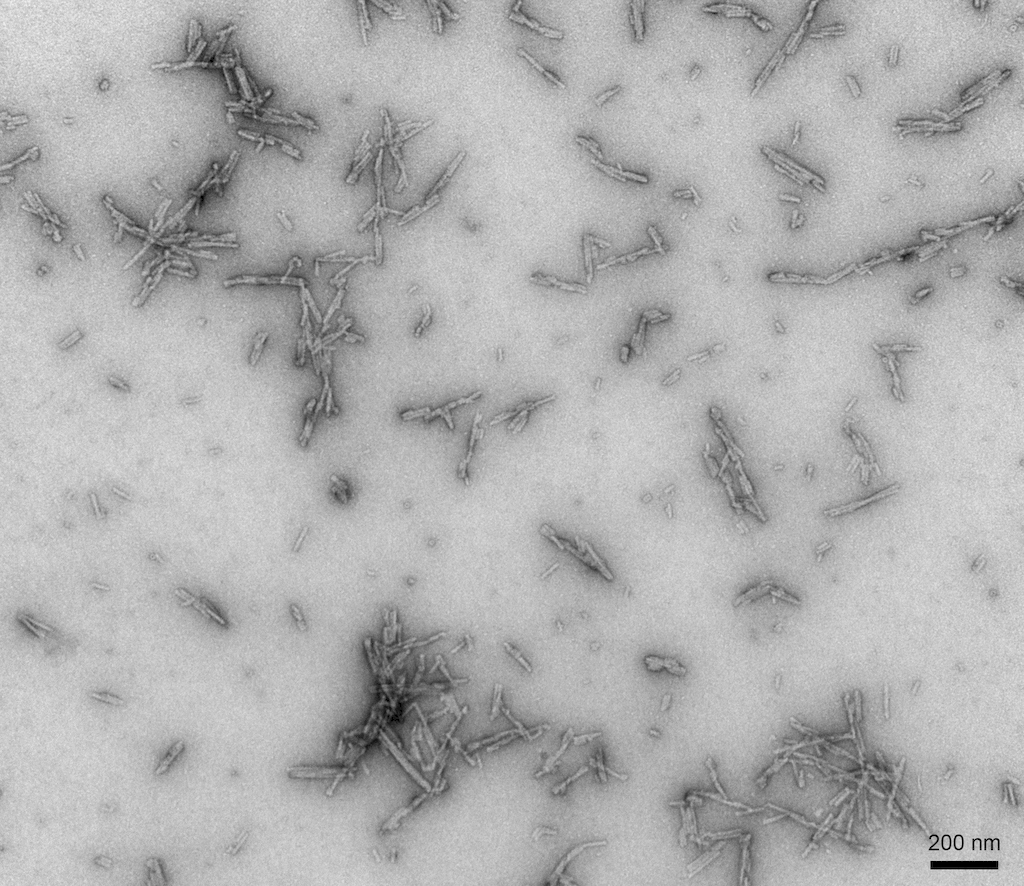
TEM of Type 2 Alpha Synuclein Pre-formed Fibrils (PFFs) (SPR-317)
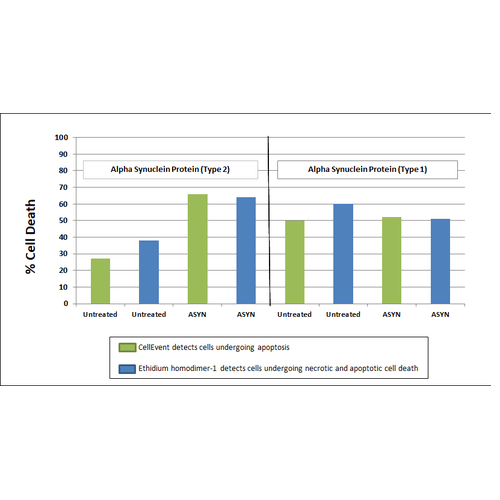
Toxicity results comparing Active Human Recombinant Alpha Synuclein Pre-formed Fibrils (Type 2) (Catalog No. SPR-317) and Active Human Recombinant Alpha Synuclein Pre-formed Fibrils (Type 1) (Catalog No. SPR-322). Data was graphed after live cell imaging results were obtained using the following procedure: After 8 days in vitro, primary rat mixed cortical neuron cells were washed with 1X PBS and treated with 500 µg/ml of Type 1 and Type 2 Alpha Synuclein Proteins for 20 hours at 37˚C. Following treatements, cells were washed with 2X PBS and incubated with a staining solution (2.0 µM Cell Event + 2.5 µM Ethidium homodimer + 2.5 µg/ml Hoechst 33342 in sterile HBSS) for 30 minutes at 37˚C. The addition of the Type 2 Alpha Synuclein Proteins resulted in a significant increase in cell death.
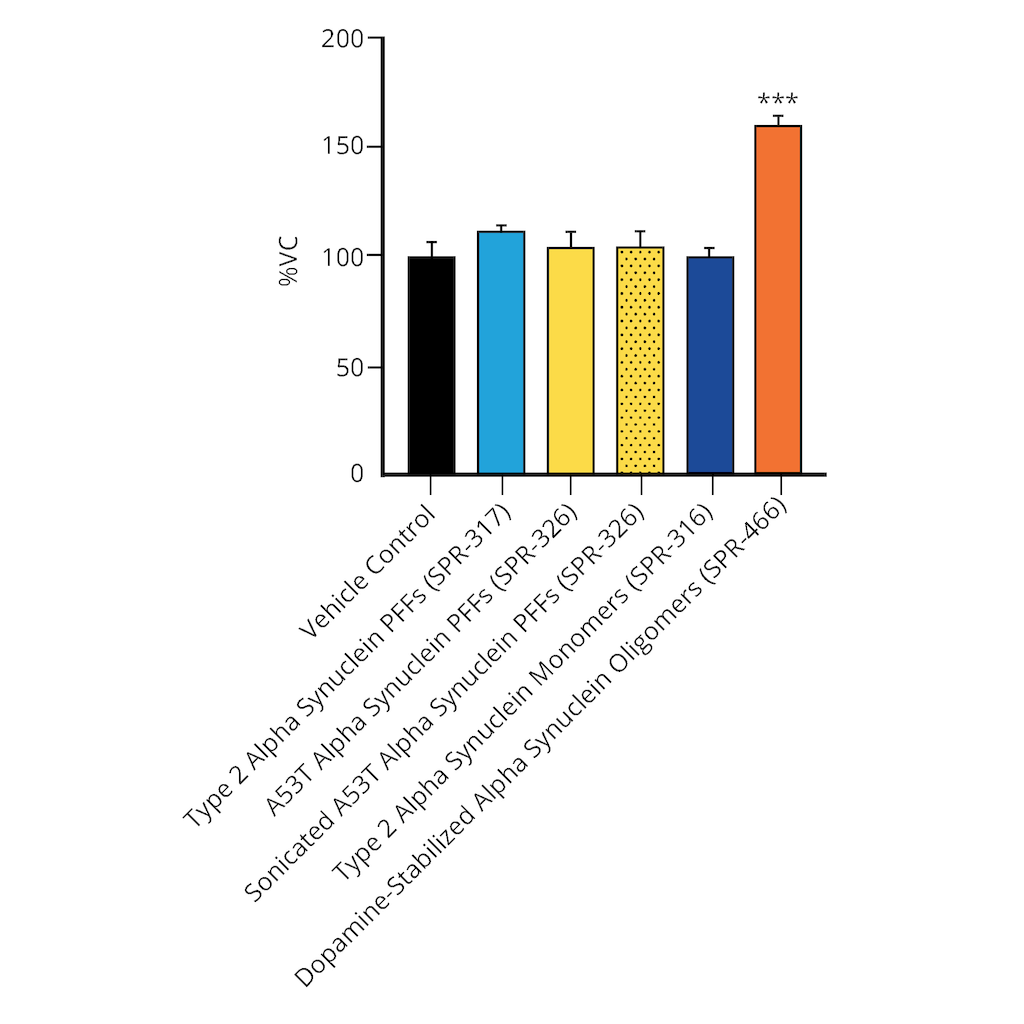
Evaluation of a-syn toxicity on primary mouse cortical neurons. Lactate dehydrogenase (LDH) is a soluble enzyme present in the cytosol that is released upon cell death. Toxicity was assessed with an LDH assay and displayed as % of vehicle control (VC). Data are presented as bar graphs and standard deviation. For statistical analysis One-way ANOVA followed by Bonferroni post-hoc test (vs VC) was used. *** p<0.001. Treatment with Type 2 PFFs did not significantly impact LDH release. Data courtesy of QPS.
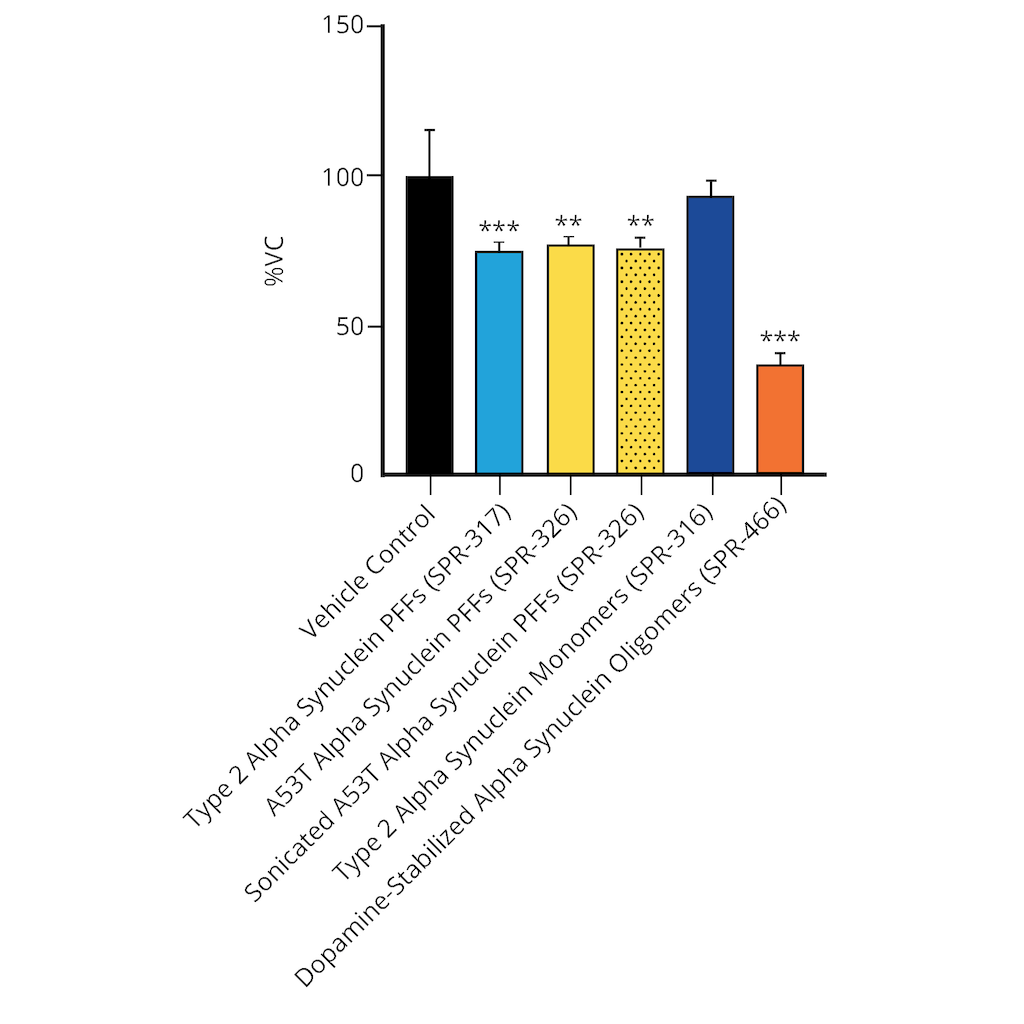
Evaluation of a-syn toxicity on primary mouse cortical neurons. Mitochondrial dehydrogenase activity reduces yellow MTT to dark blue formazan crystals, a reaction catalyzed in living cells. Cell viability was assessed with an MTT assay and displayed as % of vehicle control (VC). Data are presented as bar graphs and standard deviation. For statistical analysis One-way ANOVA followed by Bonferroni post-hoc test (vs VC) was used. ** p<0.01, *** p<0.001. Treatment with Type 2 PFFs reduced cell viability (p<0.001). Data courtesy of QPS.
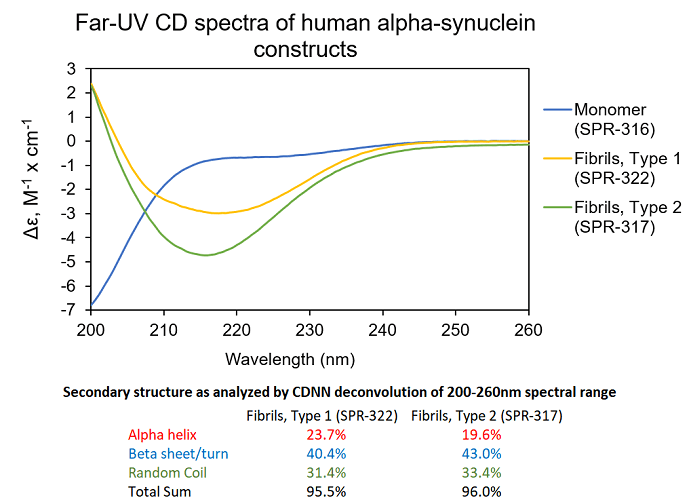
UV-CD data suggests StressMarq’s Alpha Synuclein Pre-formed Fibrils (PFF), Type 1 (cat#SPR-322) and Type 2 (cat#SPR-317) both have a high beta sheet/turn content, yet do have small secondary structure differences. StressMarq’s Alpha Synuclein Monomers (cat#SPR-316) show a strong negative signal at 200 nm indicative of a disordered protein state (low secondary structure content). For this experiment, pre-formed fibrils (PFF) were subjected to 10 cycles of sonication prior to UV-CD to ensure solubility prior to measurement.
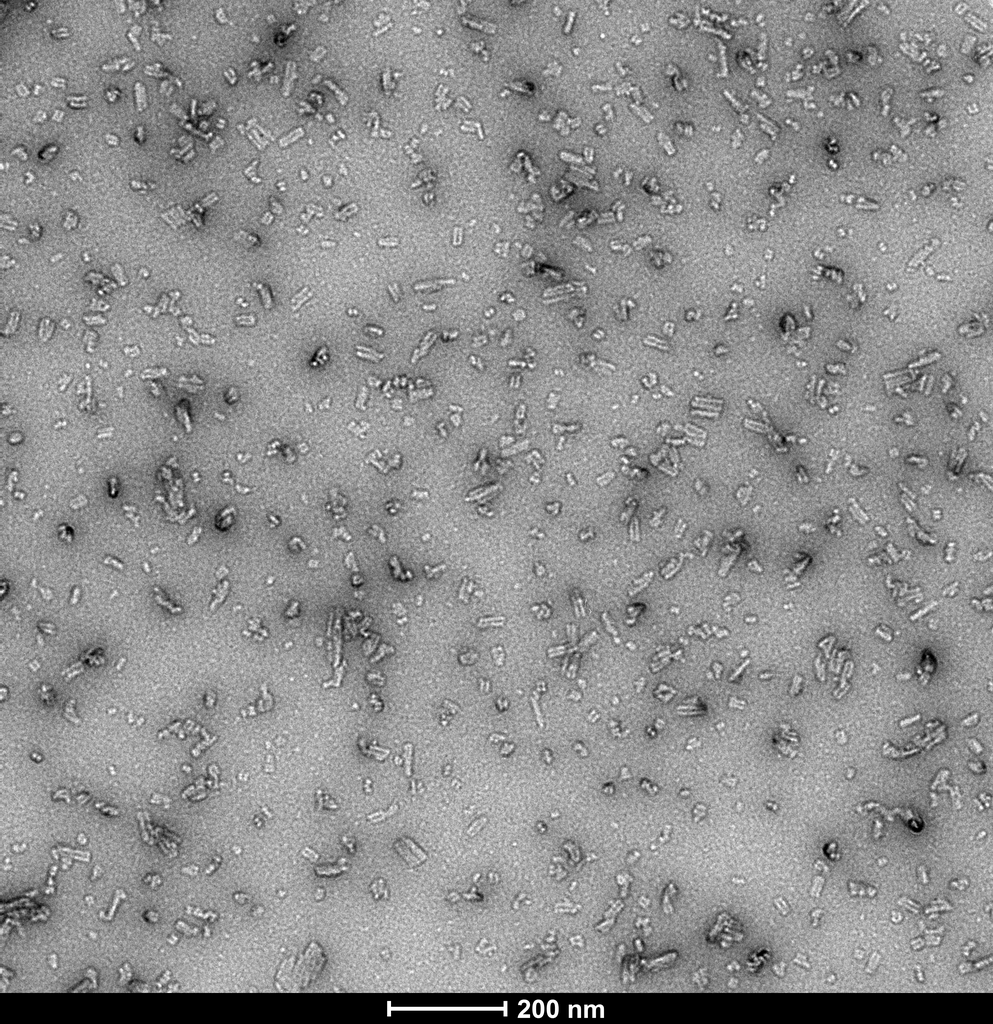
TEM of Type 2 Alpha Synuclein Fibrils (SPR-317) after 30 cycles of high frequency sonication using a Bioruptor Pico. Negative stain transmission electron microscopy (TEM) images acquired at 80 Kv on carbon coated 400 mesh copper grids using phosphotungstic acid and uranyl acetate stain. Scale bar = 200 nm.
 Powered by Bioz
StressMarq Biosciences :
Based on validation through cited publications.
Yu Zhang :
How much is it in China
Patricia Thomson :
Please contact one of our Chinese distribitors for pricing. http://www.stressmarq.com/company/distributors/