
Advancing the Frontiers of Neurodegenerative Disease Research

Properties
| Storage Buffer | PBS pH 7.4 |
| Storage Temperature | -80ºC |
| Shipping Temperature | Dry Ice. Shipping note: Product will be shipped separately from other products purchased in the same order. |
| Purification | Ion-exchange Purified |
| Cite This Product | Human Recombinant Beta Synuclein Monomers (StressMarq Biosciences | Victoria, BC CANADA | Catalog# SPR-405) |
| Certificate of Analysis | Certified >95% pure using SDS-PAGE analysis. Low endotoxin <5 EU/mL @ 2mg/mL. |
| Other Relevant Information | For corresponding PFFs, see catalog# SPR-457 |
Biological Description
| Alternative Names | Beta-synuclein, Synuclein beta, SNCB, SYUB_HUMAN, PNP14, Phosphoneuroprotein 14, 14 kDa brain-specific, G Protein Beta1/Gamma2 Subunit-Interacting Factor 1 |
| Research Areas | Alzheimer's Disease, Neurodegeneration, Neuroscience, Parkinson's Disease, Synuclein, Tangles & Tau |
| Cellular Localization | Cytoplasm |
| Accession Number | NP_001001502.1 |
| Gene ID | 6620 |
| Swiss Prot | Q16143 |
| Scientific Background |
Beta-synuclein, a soluble neuronal protein encoded by the SNCB gene, is increasingly recognized for its pivotal role in neurodegenerative disease research. Unlike its aggregation-prone counterpart alpha-synuclein, beta-synuclein monomers exhibit neuroprotective properties and are less likely to form toxic fibrils. Recent studies highlight beta-synuclein’s involvement in synaptic plasticity, regulation of dopamine metabolism, and inhibition of neuronal apoptosis. [www.uniprot.org] In Alzheimer’s disease (AD) and Lewy body dementia (LBD), elevated beta-synuclein levels in cerebrospinal fluid (CSF) and serum correlate with synaptic degeneration and disease progression. Novel assays targeting distinct epitopes of beta-synuclein have demonstrated its diagnostic potential, distinguishing early-stage AD from mild cognitive impairment and dementia. Furthermore, beta-synuclein’s dynamic expression across disease stages positions it as a promising biomarker for staging and monitoring neurodegeneration. [jnnp.bmj.com] Mechanistically, beta-synuclein modulates the phase behavior of alpha-synuclein, delaying its transition into neurotoxic aggregates. This regulatory function suggests a protective role in maintaining synaptic integrity and preventing pathological protein aggregation. [jnnp.bmj.com] As research advances, beta-synuclein monomers are emerging not only as biomarkers but also as potential therapeutic targets. Their unique biochemical properties and disease-specific expression patterns underscore their relevance in precision medicine approaches for neurodegenerative disorders. |
| References |
1. www.alz.org/alzheimers-dementia/facts-figures 2. Alzheimer, A. Über eine eigenartige Erkrankung der Hirnrinde. Allg. Z. Psychiatr. Psych.-Gerichtl. Med. 64, 146–148 (1907). 3. Taschenberger G., et al. (2013) Ann Neurol. 74(1): 109-118. |
Product Images
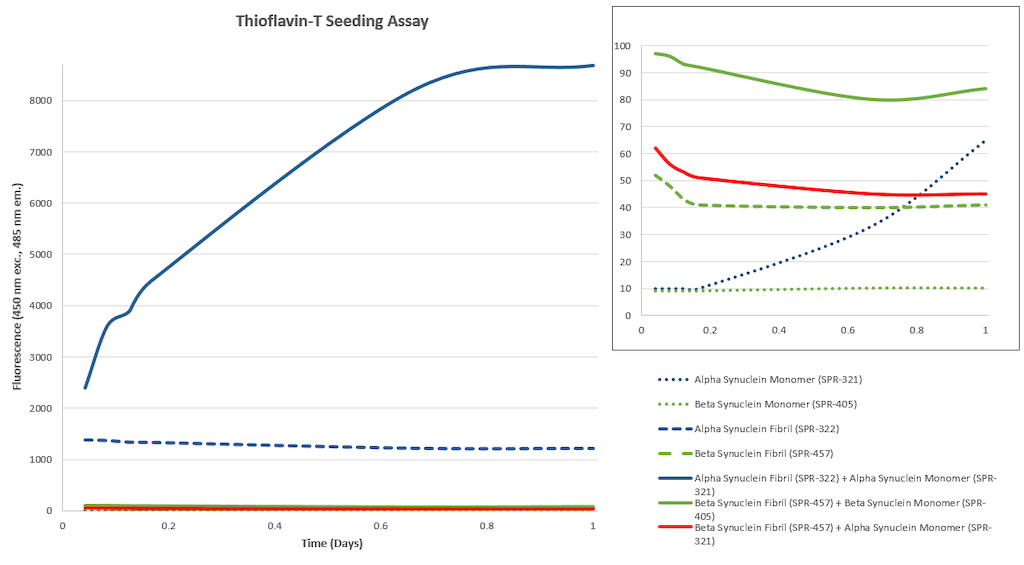
Thioflavin T is a fluorescent dye that binds to beta sheet-rich structures, such as those in alpha synuclein and beta synuclein fibrils. Beta synuclein lacks the NAC domain so its fibrils do not seed alpha synuclein or beta synuclein monomers.
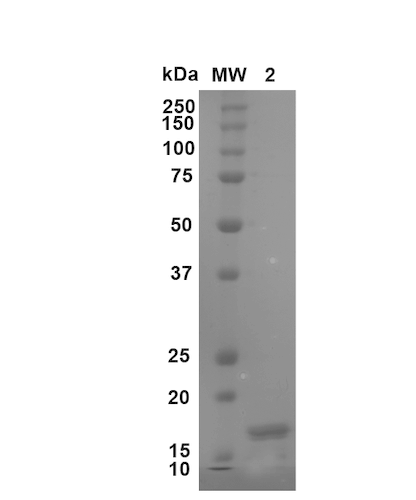
Coomassie gel stain of Human Beta Synuclein Monomer (SPR-405). Load: 2 ug.
 Powered by Bioz
Reviews
There are no reviews yet.