
Advancing the Frontiers of Neurodegenerative Disease Research

Properties
| Storage Buffer | PBS pH 7.4 |
| Storage Temperature | -80ºC |
| Shipping Temperature | Dry Ice. Shipping note: Product will be shipped separately from other products purchased in the same order. |
| Purification | Ion-exchange Purified |
| Cite This Product | Human Recombinant Gamma Synuclein Monomers (StressMarq Biosciences | Victoria, BC CANADA | Catalog# SPR-407) |
| Certificate of Analysis | Certified >95% pure using SDS-PAGE analysis. Low endotoxin <5 EU/mL @ 2mg/mL. |
| Other Relevant Information | For corresponding PFFs, see catalog# SPR-459 |
Biological Description
| Alternative Names | Gamma-synuclein, Synuclein gamma, SNCG, SYUG_HUMAN, BCSG1, Breast cancer-specific gene 1, Persyn, PRSN, SR, Synoretin, Phosphoneuroprotein 14, PNP14, 14 kDa brain-specific |
| Research Areas | Alzheimer's Disease, Neurodegeneration, Neuroscience, Parkinson's Disease, Synuclein, Tangles & Tau |
| Cellular Localization | Centrosome, Cytoskeleton, Perinuclear Region, Spindle |
| Accession Number | NP_003078.2 |
| Gene ID | 6623 |
| Swiss Prot | O76070 |
| Scientific Background |
Gamma-synuclein, encoded by the SNCG gene, is a member of the synuclein protein family, primarily expressed in the peripheral and central nervous systems. Unlike alpha-synuclein, which is extensively studied for its role in Parkinson’s disease, gamma-synuclein monomers are emerging as critical modulators of neuronal architecture and signaling pathways. Functionally, gamma-synuclein contributes to the integrity of the neurofilament network and modulates axonal structure during development and adulthood. It activates key signaling cascades, including the MAPK and Elk-1 pathways, which are implicated in neuronal survival and plasticity. Recent findings suggest that gamma-synuclein may influence neurotransmitter secretion and synapse organization, positioning it as a potential player in neurodegenerative processes. In the context of neurodegeneration, gamma-synuclein’s dysregulation has been associated with synaptic dysfunction and altered dopamine signaling—hallmarks of diseases such as Alzheimer’s and Parkinson’s. Its unique biochemical properties, including resistance to aggregation compared to alpha-synuclein, make gamma-synuclein monomers attractive candidates for biomarker development and therapeutic targeting. Ongoing research is exploring gamma-synuclein’s interactions with other neurodegenerative proteins and its role in modulating cellular stress responses. As the field advances, gamma-synuclein monomers may offer new insights into disease mechanisms and open avenues for precision diagnostics and neuroprotective interventions. |
| References | 1. Nishioka K., et al. (2010) Arch Neurol. 67(8): 970-975. 2. Surgucheva I., Newell K.L., Burns J., Surguchov A. (2014) Acta Neuropathol Commun. 2: 132. 3. Bruening. W., et al. (2000) Cancer. 88(9): 2154-2163. 4. Mukaetova-Ladinska E.B., et al. (2008) Dement Geriatr Cogn Disord. 26(1): 32-42. |
Product Images
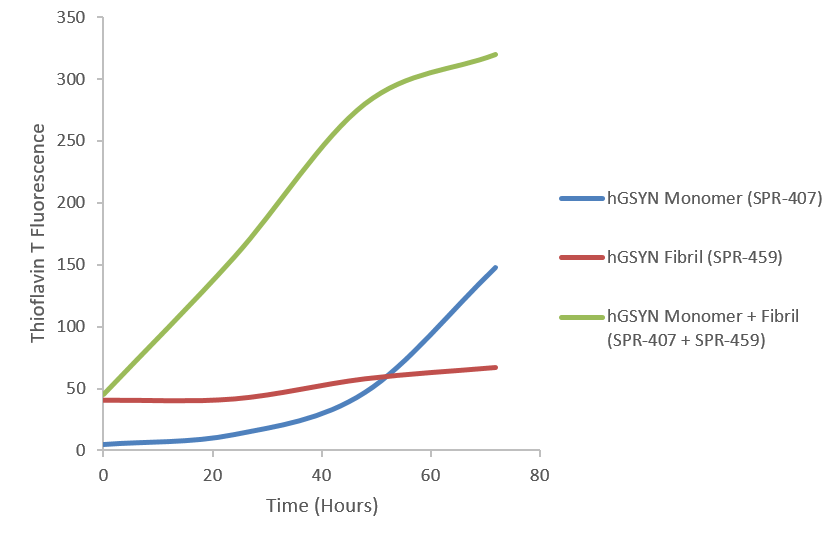
Thioflavin T is a fluorescent dye that binds to beta sheet-rich structures, such as those in gamma synuclein fibrils. Increased fluorescence (correlated to gamma synuclein fibrillization) is seen when human gamma synuclein monomer (SPR-407) is combined with human gamma synuclein PFFs (SPR-459).
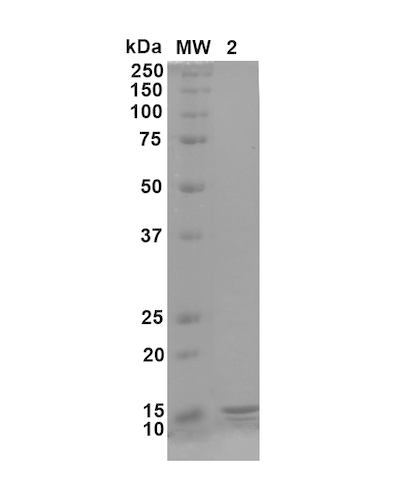
Coomassie gel stain of Human Gamma Synuclein Monomer (SPR-407). Load: 2 ug.
 Powered by Bioz
Reviews
There are no reviews yet.