
Advancing the Frontiers of Neurodegenerative Disease Research

Properties
| Storage Buffer | 10 mM HEPES pH 7.4, 100 mM NaCl |
| Storage Temperature | -80ºC |
| Shipping Temperature | Dry Ice. Shipping note: Product will be shipped separately from other products purchased in the same order. |
| Purification | Ion-exchange Purified |
| Cite This Product | Human Recombinant Tau-410 (2N3R) Wild-Type Pre-formed Fibrils (StressMarq Biosciences | Victoria, BC CANADA | Catalog# SPR-535) |
| Certificate of Analysis | Starting Monomers certified > 95% pure via SDS-PAGE and A260/A280 ratio. |
| Other Relevant Information | For corresponding monomer, see catalog# SPR-534 |
Biological Description
| Alternative Names | Tau-410, 2N3R Tau, Tau isoform 2, MAPT isoform 2, Tau 410-amino acid isoform, 2N Tau, 3R Tau, 2N3R MAPT isoform, Neurofibrillary tangle protein, Microtubule-associated protein tau, MAPT, Tau protein 2N3R, Human Tau 2N3R, Non-repeat-insert Tau (two inserts), Tau long isoform (410 aa) |
| Research Areas | Alzheimer's Disease, Neurodegeneration, Neuroscience, Tangles & Tau |
| Swiss Prot | P10636-5 |
| Scientific Background | Tau 2N3R, one of the six brain specific isoforms generated by MAPT alternative splicing, has garnered increasing attention in neurodegenerative disease research because isoform specific imbalances contribute to tauopathy onset and progression. As a 2 insert, 3 repeat variant, Tau 2N3R participates in microtubule stabilization and axonal transport, yet becomes pathologically modified through aberrant phosphorylation and proteolytic fragmentation, processes known to promote toxic oligomer formation and neurofibrillary tangle development in diseases such as Alzheimer’s and frontotemporal lobar degeneration. These pathogenic transformations impair cytoskeletal integrity, disrupt neuronal signaling, and drive widespread neurodegeneration, underscoring the importance of isoform specific mechanisms in therapeutic development. StressMarq’s Tau-410 (2N3R) PFFs provide a robust platform for developing tau-related disease models. Their application accelerates translational research focused on mitigating tau-driven neurodegeneration and improving outcomes for patients with tau-related disorders. |
| References |
1. Buchholz, S., & Zempel, H. (2024). The six brain-specific TAU isoforms and their role in Alzheimer’s disease and related neurodegenerative dementia syndromes. Alzheimer’s Association Journals. https://doi.org/10.1002/alz.13784 2. Zhang, X., Wang, J., Zhang, Z., & Ye, K. (2024). Tau in neurodegenerative diseases: Molecular mechanisms, biomarkers, and therapeutic strategies. Translational Neurodegeneration, 13, 40. https://doi.org/10.1186/s40035-024-00429-6 3. Boyarko, B., & Hook, V. (2021). Human tau isoforms and proteolysis for production of toxic tau fragments in neurodegeneration. Frontiers in Neuroscience, 15. https://doi.org/10.3389/fnins.2021.702788 |
Product Images
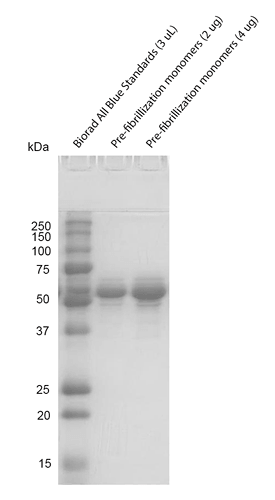
SDS-PAGE analysis of purified Human Recombinant Tau-410 (2N3R) Monomers on a 12% Tris-Glycine gel. Purity and concentration of monomers are visually confirmed prior to fibrillization.
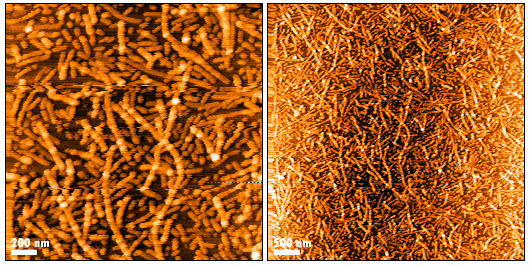
Atomic force microscopy analysis of Human Recombinant Tau-410 (2N3R) Pre-formed Fibrils (cat # SPR-535) diluted to 0.1 mg/mL with dH2O, mounted on freshly cleaved mica, washed, dried and analyzed with tapping mode. Representative images are 2 x 2 µm x-y (left) and 5 x 5 µm x-y (right).
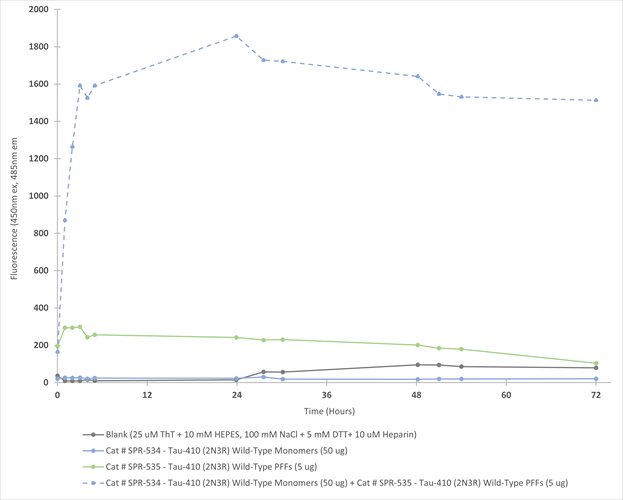
In vitro seeding activity of Human Recombinant Tau-410 (2N3R) Pre-formed Fibrils in Thioflavin T (ThT) seeding assay. Human Recombinant Tau-410 (2N3R) Pre-formed Fibrils (cat # SPR-535) seed fibril formation of Human Recombinant Tau-410 (2N3R) Monomers (cat # SPR-534) over 72 hours. Reactions (100uL) shaken at 600 rpm in Greiner-Bio 96 Well Non-Binding Cell Culture Microplates, Black (Greiner-Bio Catalog #655900) at 37oC in the presence of 25 uM ThT, 5 mM DTT, and 10 uM Heparin, and read with an XPS Microplate Reader set at 450nm ex/485nm em.
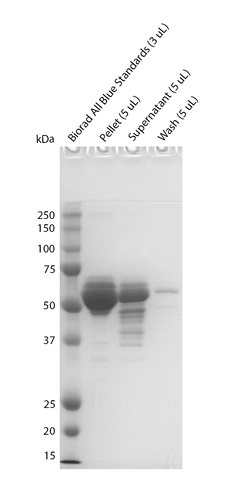
Sedimentation assay on Human Recombinant Tau-410 (2N3R) Pre-formed Fibrils. Samples were spun down at 15,000 x g, washed, and then spun down again. Fibril samples are prepared in denaturing conditions prior to running on the gel. SDS-PAGE analysis on a 12% Tris-Glycine gel shows that the majority of the fibril is insoluble.
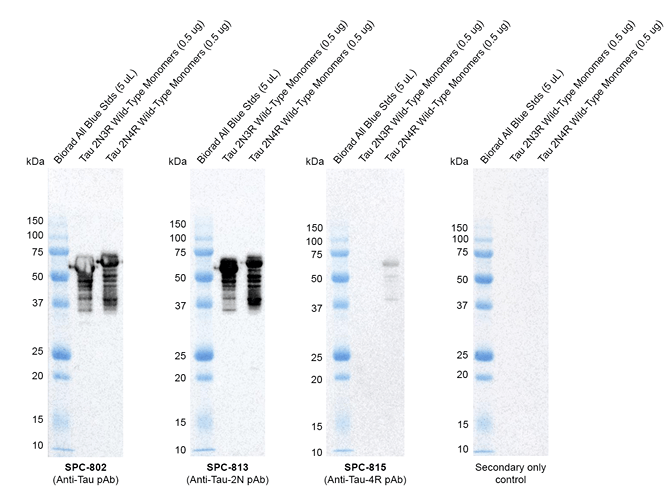
Western blot analysis of purified Human Recombinant Tau-410 (2N3R) Monomers (cat # SPR-534) using StressMarq’s Rabbit-Anti-Human Tau Polyclonal (cat # SPC-802), Tau-2N Polyclonal (cat # SPC-813), and Tau-4R Polyclonal (cat # SPC-815). Protein was transferred to nitrocellulose, incubated with 1:1000 primary antibodies and/or 1:4000 secondary antibodies. Secondary control is goat-anti rabbit:HRP. Exposed 0.5 second.
 Powered by Bioz
Reviews
There are no reviews yet.