
Advancing the Frontiers of Neurodegenerative Disease Research

Properties
| Storage Buffer | 10mM Hepes pH 7.4, 100mM NaCl |
| Storage Temperature | -80ºC |
| Shipping Temperature | Dry Ice. Shipping note: Product will be shipped separately from other products purchased in the same order. |
| Purification | Ion-exchange Purified |
| Cite This Product | Human Recombinant Tau-412 (1N4R) Wild-Type Monomers (StressMarq Biosciences | Victoria, BC CANADA | Catalog# SPR-511) |
| Certificate of Analysis | Protein certified >95% pure on SDS-PAGE & Nanodrop analysis. Low endotoxin <5 EU/mL @ 2mg/mL. |
| Other Relevant Information | For corresponding PFFs, see catalog# SPR-512 |
Biological Description
| Alternative Names | Tau 412, Tau-E, Tau-D, Tau-40, MAPT, TAU, MTBT1, MTBT2, MAPTL, PPND, PPP1R103, FTDP-17, PHF-Tau, Paired Helical Filament-Tau, Neurofibrillary Tangle, Microtubule-associated tau, Isoform 4, G Protein Beta1/Gamma2 Subunit-Interacting Factor 1 |
| Research Areas | Alzheimer's Disease, Neurodegeneration, Neuroscience, Tangles & Tau |
| Swiss Prot | P10636-7 |
| Scientific Background |
Tau-412, also known as the 1N4R isoform of the microtubule-associated protein tau (MAPT), is a naturally occurring variant composed of 412 amino acids. It includes one N-terminal insert and four microtubule-binding repeat domains, contributing to its role in stabilizing microtubules and maintaining neuronal architecture. In healthy neurons, Tau-412 supports axonal transport and cytoskeletal integrity. However, under pathological conditions, Tau-412 monomers can misfold and initiate aggregation into toxic oligomers and fibrils. These aggregates are central to the development of tauopathies such as Alzheimer’s disease, progressive supranuclear palsy, and corticobasal degeneration. Tau-412 wild-type monomers are widely used in neurodegenerative disease research to model early tau aggregation events. Their defined structure and high aggregation propensity make them ideal for in vitro studies, biophysical characterization, and therapeutic screening. Researchers utilize these monomers to investigate the molecular triggers of tau misfolding, the impact of post-translational modifications, and the mechanisms of tau-mediated neurotoxicity. By enabling precise analysis of tau dynamics, Tau-412 monomers provide a robust platform for developing targeted therapies aimed at preventing aggregation, enhancing tau clearance, and restoring neuronal function. Their application accelerates translational research focused on mitigating tau-driven neurodegeneration and improving outcomes for patients with tau-related disorders. |
| References |
1. Goedert et al. 1989. Multiple isoforms of human microtubule-associated protein tau: sequences and localization in neurofibrillary tangles of Alzheimer’s disease. Neuron. DOI: 10.1016/0896-6273(89)90210-9 2. Goedert, Eisenberg and Crowther. 2017. Propagation of Tau Aggregates and Neurodegeneration. Annual Review of Neuroscience. DOI: 10.1146/annurev-neuro-072116-031153 3. Dregni et al. 2022. Fluent molecular mixing of Tau isoforms in Alzheimer’s disease neurofibrillary tangles. Nature communications. DOI: 10.1038/s41467-022-30585-0 |
Product Images
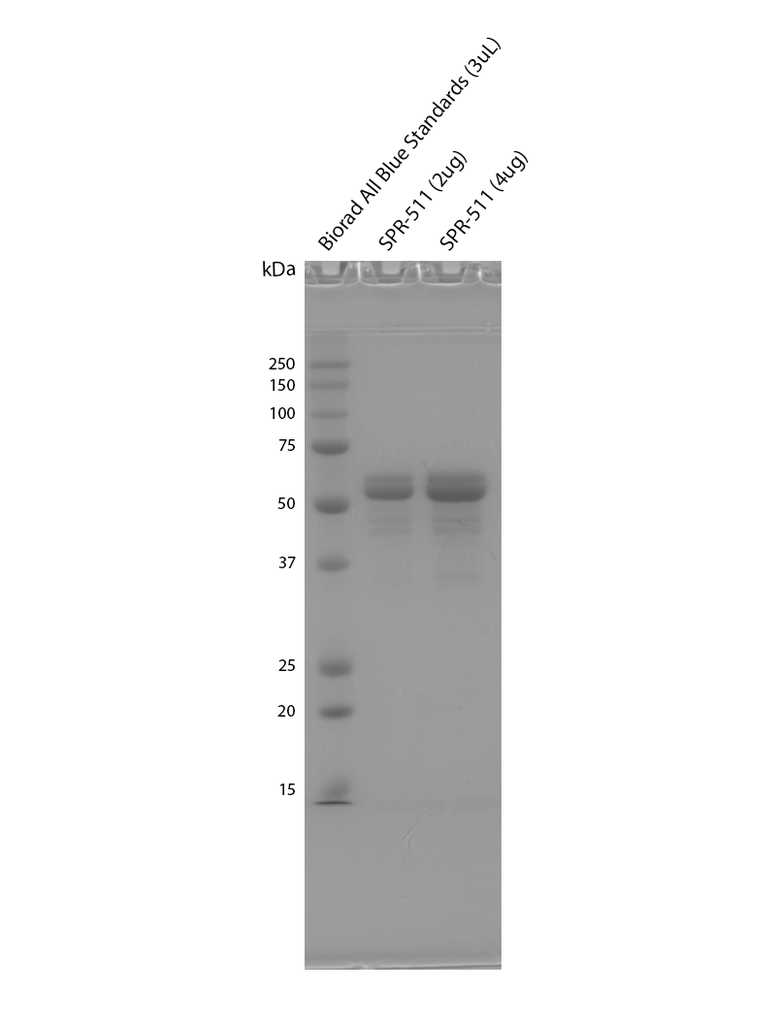
SDS-PAGE analysis of purified E. coli expressed hTau-412 (1N4R) monomer on a 12% Tris-Glycine gel.
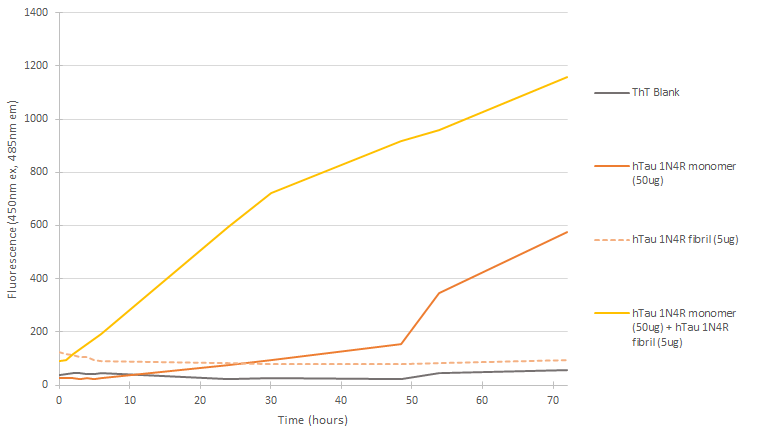
In vitro seeding activity of human Tau-412 (1N4R) monomer in ThT assay. Tau 1N4R pre-formed fibrils seed fibril formation of human Tau-412 (1N4R) monomers over 72 hours. Reactions (100uL) shaken at 600 rpm in Greiner-Bio 96 Well Non-Binding Cell Culture Microplates, Black (Greiner-Bio Catalog #655900) at 37oC in the presence of 25 uM ThT and 10 uM heparin and read with an XPS Microplate Reader set at 450nmex/485nmem.
 Powered by Bioz
Reviews
There are no reviews yet.