
Advancing the Frontiers of Neurodegenerative Disease Research

| Product Name | ISRIB |
| Description |
Stress Response Inhibitor |
| Purity | >98% (TLC); NMR (Conforms) |
| CAS No. | 1597403-47-8 |
| Molecular Formula | C22H24Cl2N2O4 |
| Molecular Weight | 451.3 |
| Field of Use | Not for use in humans. Not for use in diagnostics or therapeutics. For in vitro research use only. |
Properties
| Storage Temperature | -20ºC |
| Shipping Temperature | Shipped Ambient |
| Product Type | Inhibitor |
| Solubility | May be dissolved in DMSO (5 mg/ml, warm) |
| Source | Synthetic |
| Appearance | White powder |
| SMILES | C1CC(CCC1NC(=O)COC2=CC=C(C=C2)Cl)NC(=O)COC3=CC=C(C=C3)Cl |
| InChI | InChI=1S/C22H24Cl2N2O4/c23-15-1-9-19(10-2-15)29-13-21(27)25-17-5-7-18(8-6-17)26-22(28)14-30-20-11-3-16(24)4-12-20/h1-4,9-12,17-18H,5-8,13-14H2,(H,25,27)(H,26,28) |
| InChIKey | HJGMCDHQPXTGAV-UHFFFAOYSA-N |
| Safety Phrases | Not a hazardous substance or mixture. |
| Cite This Product | ISRIB (StressMarq Biosciences | Victoria, BC CANADA | Catalog# SIH-645) |
Biological Description
| Alternative Names | N,N'-trans-1,4-Cyclohexanediylbis[2-(4-chlorophenoxy)acetamide]; trans-ISRIB |
| Research Areas | Alzheimer's Disease, Amyloid, Neurodegeneration, Neuroscience |
| PubChem ID | 1011240 |
| Scientific Background | ISRIB is a blood–brain barrier–penetrant, potent, and selective inhibitor of the integrated stress response (ISR) that impairs cellular adaptation to endoplasmic reticulum (ER) stress. It potently reverses the effects of eukaryotic initiation factor 2α (eIF2α) phosphorylation (IC₅₀ ≈ 5 nM), restoring protein translation capacity through a mechanism involving activation of eIF2β and inhibition of PERK signaling. In addition, ISRIB suppresses ER stress–induced inflammatory gene expression and demonstrates significant neuroprotective activity, potently attenuating amyloid β–induced neuronal cell death (12.5–25 nM) without affecting amyloid β production. Functionally, ISRIB enhances spatial and fear-associated learning in mice, improves overall cognitive function, and has been shown to reverse hippocampal-dependent cognitive deficits in multiple traumatic brain injury models. These findings highlight its relevance in neuroscience research, particularly in studies of neurodegeneration and brain injury. |
| References |
1. Sidrauski C., et al. (2013) Elife 2:e00498 2. Sekine Y., et al. (2015) Science 348:1027 3. Sidrauski C.,et al. (2015) Elife 4:e07314 4. Guthrie L.N., et al. (2016) J. Biol. Chem. 291:15830 5. Hosoi T., et al. (2016) J. Pharmacol. Sci.131:292 6. Chou A., et al. (2017) Proc. Natl. Acad. Sci. USA 114:E6420 7. Cadavid J.M. et al. (2025) Amyotropho Lateral Scler Frontotemporal Degener. 26(7-8): 821-9824. |
Product Images
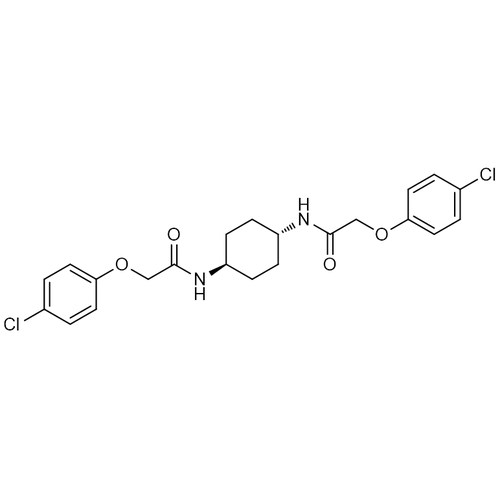
Chemical structure of ISRIB (SIH-645), a Stress response inhibitor. CAS #: 1597403-47-8. Molecular Formula: C22H24Cl2N2O4. Molecular Weight: 451.3 g/mol.
 Powered by Bioz
Reviews
There are no reviews yet.