
Advancing the Frontiers of Neurodegenerative Disease Research

| Product Name | Leupeptin hemisulfate |
| Description |
Protease Inhibitor |
| Purity | >97% (TLC); NMR (Conforms); Peptide content >85% |
| CAS No. | 103467-89-7 |
| Molecular Formula | C20H38N6O4 * 1/2H2SO4 |
| Molecular Weight | 475.6 |
| Field of Use | Not for use in humans. Not for use in diagnostics or therapeutics. For in vitro research use only. |
Properties
| Storage Temperature | -20ºC |
| Shipping Temperature | Shipped Ambient |
| Product Type | Inhibitor |
| Solubility | May be dissolved in water (50 mg/mL) or ethanol or methanol |
| Source | Synthetic |
| Appearance | White powder |
| SMILES | CC(C)C[C@@H](C(=O)N[C@@H](CC(C)C)C(=O)N[C@@H](CCCN=C(N)N)C=O)NC(=O)C.CC(C)C[C@@H](C(=O)N[C@@H](CC(C)C)C(=O)N[C@@H](CCCN=C(N)N)C=O)NC(=O)C.OS(=O)(=O)O |
| InChI | InChI=1S/2C20H38N6O4.H2O4S/c2*1-12(2)9-16(24-14(5)28)19(30)26-17(10-13(3)4)18(29)25-15(11-27)7-6-8-23-20(21)22;1-5(2,3)4/h2*11-13,15-17H,6-10H2,1-5H3,(H,24,28)(H,25,29)(H,26,30)(H4,21,22,23);(H2,1,2, |
| InChIKey | CIPMKIHUGVGQTG-VFFZMTJFSA-N |
| Safety Phrases |
Signal word: Warning Hazard statement(s): H361 Suspected of damaging fertility or the unborn child Precautionary statement(s): P280 Wear protective gloves/protective clothing/eye protection/face protection P308+313 If exposed or concerned: Get medical advice/attention |
| Cite This Product | Leupeptin hemisulfate (StressMarq Biosciences | Victoria, BC CANADA | Catalog# SIH-649) |
Biological Description
| Alternative Names | Ac-Leu-Leu-Arg-CHO hemisulfate |
| Research Areas | Alzheimer's Disease, Cell Signaling, Neurodegeneration, Neuroscience, Parkinson's Disease |
| PubChem ID | 2733491 |
| Scientific Background | Leupeptin hemisulfate is a broad-spectrum protease inhibitor utilized in neuroscience research to investigate neuroinflammation, autophagy, and neurodegenerative disease pathways. By suppressing inflammatory signaling and oxidative stress responses, it serves as a useful tool for studying microglial activation, lysosomal function, protein turnover, and neuronal injury, making it relevant to research in Alzheimer's disease, Parkinson's disease, and other CNS disorders. |
| References |
1. Haspel, J., et al.. (2011). Autophagy. 7(6), 629-642. https://doi.org/10.4161/auto.7.6.15100 2. Nixon, R. A., & Rubinsztein, D. C. (2024). Nature Reviews Molecular Cell Biology, 25(11), 926-946. https://doi.org/10.1038/s41580-024-00757-5 3. Udayar, V., Chen, Y., Sidransky, E., & Jagasia, R. (2022). Trends in Neurosciences, 45(3), 184-199. https://doi.org/10.1016/j.tins.2021.12.004 |
Product Images
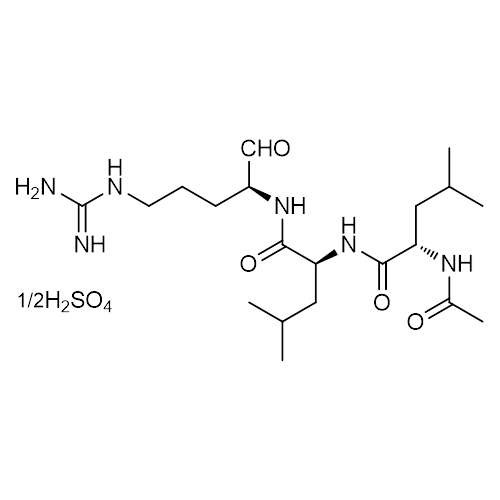
Chemical structure of Leupeptin hemisulfate (SIH-649), a Protease Inhibitor. CAS #: 103476-89-7. Molecular Formula: C20H38N6O4 * 1/2H2SO4. Molecular Weight: 475.6 g/mol.
 Powered by Bioz
Reviews
There are no reviews yet.