
Advancing the Frontiers of Neurodegenerative Disease Research

| Product Name | SW033291 |
| Description |
15-PGDH Inhibitor |
| Purity | ≥98% (HPLC); NMR (Conforms) |
| CAS No. | 459147-39-8 |
| Molecular Formula | C21H20N2OS3 |
| Molecular Weight | 412.6 |
| Field of Use | Not for use in humans. Not for use in diagnostics or therapeutics. For in vitro research use only. |
Properties
| Storage Temperature | -20ºC |
| Shipping Temperature | Shipped Ambient |
| Product Type | Inhibitor |
| Solubility | May be dissolved in water (25 mg/ml, warm) |
| Source | Synthetic |
| Appearance | White powder |
| SMILES | NC1=C(S(CCCC)=O)SC2=NC(C3=CC=CS3)=CC(C4=CC=CC=C4)=C21 |
| InChI | 1S/C21H20N2OS3/c1-2-3-12-27(24)21-19(22)18-15(14-8-5-4-6-9-14)13-16(23-20(18)26-21)17-10-7-11-25-17/h4-11,13H,2-3,12,22H2,1H3 |
| InChIKey | LCYAYKSMOVLVRL-UHFFFAOYSA-N |
| Safety Phrases |
Classification: Warning Hazard statements : H315 Causes skin irritation. H319 Causes serious eye irritation. H335 May cause respiratory irritation. Precautionary statements : Prevention: P261 Avoid breathing dust. P264 Wash skin thoroughly after handling. P271 Use only outdoors or in a well-ventilated area. P280 Wear protective gloves/ eye protection/ face protection. Response: P302 + P352 IF ON SKIN: Wash with plenty of water. P304 + P340 + P312 IF INHALED: Remove person to fresh air and keep comfortable for breathing. Call a POISON CENTER/ doctor if you feel unwell. P305 + P351 + P338 IF IN EYES: Rinse cautiously with water for several minutes. Remove contact lenses, if present and easy to do. Continue rinsing. P332 + P313 If skin irritation occurs: Get medical advice/ attention. P337 + P313 If eye irritation persists: Get medical advice/ attention. P362 + P364 Take off contaminated clothing and wash it before reuse. |
| Cite This Product | SW033291 (StressMarq Biosciences | Victoria, BC CANADA | Catalog# SIH-647) |
Biological Description
| Alternative Names | 4-Butylsulfinyl-4-phenyl-6-thiophen-2-ylthieno[2,3-b]pyridin-3-amine |
| Research Areas | Alzheimer's Disease, Immunology, Neurodegeneration, Neuroscience, Parkinson's Disease |
| PubChem ID | 3337839 |
| Scientific Background | SW033291 is a potent, selective inhibitor of 15-hydroxyprostaglandin dehydrogenase, the primary enzyme responsible for prostaglandin E₂ (PGE₂) degradation. By elevating endogenous PGE₂ levels, SW033291 promotes tissue regeneration and repair across multiple organ systems. In preclinical studies, 15-PGDH inhibition accelerated neutrophil, platelet, and red blood cell recovery following bone marrow transplantation while expanding hematopoietic stem and progenitor cell populations. It also enhanced colon epithelial regeneration, stimulated bone formation through PGE₂-mediated EP4 receptor activation, and protected against hepatic ischemia-reperfusion injury. Recent studies have demonstrated significant neuroprotective activity, with 15-PGDH inhibition reducing oxidative stress and neuroinflammation, preserving blood-brain barrier integrity, and preventing neurodegeneration in mouse models of Alzheimer's disease and traumatic brain injury, while maintaining cognitive function at levels comparable to healthy controls. Furthermore, 15-PGDH inhibition has shown therapeutic potential in Parkinson's disease models by restoring redox homeostasis, reducing neuronal loss and neuroinflammation, and improving motor outcomes, supporting its potential as a broad-spectrum regenerative and neuroprotective strategy. |
| References |
1. Zhang Y, Desai A, Yang SY, et al. Inhibition of the prostaglandin-degrading enzyme 15-PGDH potentiates tissue regeneration. Science. 2015;348:aaa2340. 2. Chen A, Zhao L, Leong F, et al. PGE2 promotes hematopoietic regeneration and stem cell expansion. Nat Commun. 2019;10:181. 3. Xie M, Chen H, Wang Z, et al. 15-PGDH inhibition protects against hepatic ischemia-reperfusion injury. Biochem Biophys Res Commun. 2022;615:70-77. 4. Koh Y, Vázquez-Rosa E, Gao F, et al. Inhibiting 15-PGDH blocks blood-brain barrier deterioration and protects mice from Alzheimer's disease and traumatic brain injury. Proc Natl Acad Sci U S A. 2025;122:e2417224122. 5. Kim YK, Cha YJ, Park SE, et al. Inhibiting 15-PGDH restores redox homeostasis and confers neuroprotection in Parkinson's disease. Redox Biology. 2026;95:104285. |
Product Images
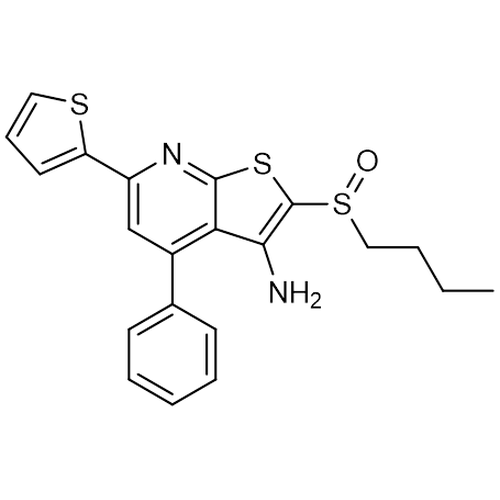
Chemical structure of SW033291 (SIH-647), a 15-PGDH Inhibitor. CAS #: 459147-39-8. Molecular Formula: C21H20N2OS3. Molecular Weight: 412.6 g/mol.
 Powered by Bioz
Reviews
There are no reviews yet.