
Advancing the Frontiers of Neurodegenerative Disease Research

| Product Name | Olesoxime |
| Description |
Neuroprotective Agent |
| Purity | >98% (TLC); NMR (Conforms) |
| CAS No. | 22033-87-0 |
| Molecular Formula | C27H45NO |
| Molecular Weight | 399.7 |
| Field of Use | Not for use in humans. Not for use in diagnostics or therapeutics. For in vitro research use only. |
Properties
| Storage Temperature | -20ºC |
| Shipping Temperature | Shipped Ambient |
| Product Type | Neuroprotective Agent |
| Solubility | May be dissolved in DMSO (20 mg/ml); or ethanol (25 mg/ml) |
| Source | Synthetic |
| Appearance | White crystalline powder |
| SMILES | C[C@H](CCCC(C)C)[C@H]1CC[C@@H]2[C@@]1(CC[C@H]3[C@H]2CCC4=CC(=NO)CC[C@]34C)C |
| InChI | InChI=1S/C27H45NO/c1-18(2)7-6-8-19(3)23-11-12-24-22-10-9-20-17-21(28-29)13-15-26(20,4)25(22)14-16-27(23,24)5/h17-19,22-25,29H,6-16H2,1-5H3/t19-,22+,23-,24+,25+,26+,27-/m1/s1 |
| InChIKey | QNTASHOAVRSLMD-GYKMGIIDSA-N |
| Safety Phrases | Not a hazardous substance or mixture. |
| Cite This Product | Olesoxime (StressMarq Biosciences | Victoria, BC CANADA | Catalog# SIH-644) |
Biological Description
| Alternative Names | TRO 19622; Cholest-4-en-3-one oxime |
| Research Areas | Alzheimer's Disease, Ion Channels, Neurodegeneration, Neuroscience, Neurotransmission |
| PubChem ID | 76971721 |
| Scientific Background |
Olesoxime is a neuroregenerative and neuroprotective agent that acts on components of the mitochondrial permeability transition pore (mPTP). It rescues motor neurons from axotomy‑induced cell death and promotes nerve regeneration following sciatic nerve crush in mice. Olesoxime inhibits mPTP opening, protects neurons from apoptosis, and reduces reactive oxygen species production and NLRP3 inflammasome activation in models of intracerebral hemorrhage. It also induces oligodendrocyte maturation in vitro and promotes myelin regeneration in rodent models. In preclinical neuroscience studies, olesoxime has been shown to improve cerebral mitochondrial dysfunction and modulate amyloid‑β pathology in models of Alzheimer’s disease. Reviews of olesoxime across neurodegenerative disease models highlight its potential as a therapeutic candidate due to its ability to stabilize mitochondrial function and enhance neuronal survival. |
| References |
1. Bordet T. et.al. Journal of Pharmacology and Experimental Therapeutics (2007), 322:709 2. Ma Q. et.al. Annals of Neurology (2014), 75:209 3. Martin L.J. et.al. Journal of Neuroscience (2011), 31:359 4. Magalon K et.al. Neuropharmacology (2016), 111:293 5. Eckert G.P. et al. Exp Neurol. (2020), 329:113286. PubMed ID: 32199815 6. Weber J.J., Clemensson L.E., Schioth H.B., and Nguyen H.P. Biochem Pharmacol. (2019). 168-305-318. PubMed ID: 31283931 |
Product Images
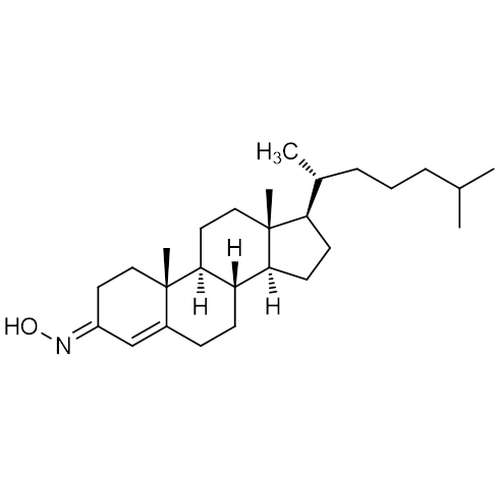
Chemical structure of Olesoxime (SIH-644), a mitochondrial-targeted neuroprotective compound. CAS #: 22033-87-0. Molecular Formula: C27H45NO. Molecular Weight: 399.7 g/mol.
 Powered by Bioz
Reviews
There are no reviews yet.