
Advancing the Frontiers of Neurodegenerative Disease Research
| Product Name | SNAP |
| Description |
Nitric Oxide Donor |
| Purity | >98%; NMR (Conforms) |
| CAS No. | 79032-48-7 |
| Molecular Formula | C7H12N2O4S |
| Molecular Weight | 220.2 |
| Field of Use | Not for use in humans. Not for use in diagnostics or therapeutics. For in vitro research use only. |
Properties
| Storage Temperature | -20ºC |
| Shipping Temperature | Shipped Ambient |
| Product Type | Nitric Oxide Donor |
| Solubility | May be dissolved in DMSO (25 mg/ml) |
| Source | Synthetic |
| Appearance | Green powder |
| SMILES | CC(=O)N[C@@H](C(=O)O)C(C)(C)SN=O |
| InChI | InChI=1S/C7H12N2O4S/c1-4(10)8-5(6(11)12)7(2,3)14-9-13/h5H,1-3H3,(H,8,10)(H,11,12)/t5-/m0/s1 |
| InChIKey | ZIIQCSMRQKCOCT-YFKPBYRVSA-N |
| Safety Phrases |
Signal word: Warning Hazard statement(s): H315: Causes skin irritation H319: Causes serious eye irritation H335: May cause respiratory irritatio Precautionary statement(s): P261: Avoid breathing dust, fumes, gas, mist, vapors, or spray. P264: Wash hands and exposed skin thoroughly after handling. P271: Use only outdoors or in a well-ventilated area. P280: Wear protective gloves, protective clothing, eye protection, and face protection. P302 + P352: IF ON SKIN: Wash with plenty of water. P305 + P351 + P338: IF IN EYES: Rinse cautiously with water for several minutes. Remove contact lenses, if present and easy to do. Continue rinsing |
| Cite This Product | SNAP (StressMarq Biosciences | Victoria, BC CANADA | Catalog# SIH-650) |
Biological Description
| Alternative Names | S-Nitroso-N-acetyl-D,L-penicillamine |
| Research Areas | Cell Signaling, Neurodegeneration, Neuroscience, Oxidative Stress |
| PubChem ID | 6603945 |
| Scientific Background | S-Nitroso-N-acetyl-DL-penicillamine (SNAP) is a stable nitric oxide (NO) donor widely used in neuroscience research to investigate NO signaling, neuroinflammation, and neurodegenerative disease mechanisms. With a half-life of approximately 5 hours at physiological pH, SNAP provides sustained NO release for studying neuronal and glial responses. In the CNS, NO regulates synaptic plasticity, neurotransmission, cerebral blood flow, and neuron-glia communication. SNAP has been shown to promote neuronal survival following serum deprivation and to reverse temozolomide resistance in human glioblastoma cells. It is a valuable tool for studying oxidative and nitrosative stress, neuroprotection, neuro-oncology, and the role of NO signaling in disorders such as Alzheimer's disease, Parkinson's disease, and stroke. |
| References |
1. Roy, B., Lepoivre, M., Henry, Y., & Fontecave, M. (1994). Journal of Organic Chemistry, 59, 7019-7026. 2. Fan, Q., et al. (2025). Nitric Oxide, 158, 27-36. 3. Bauer, J. A., & Fung, H. L. (1991). Journal of Pharmacology and Experimental Therapeutics, 256(1), 249-254. 4. Figueroa, S., Cortés-Campos, C., & Tapia, R. (2005). Brain Research, 1034(1-2), 25-33. 5. Tsai, C.-K., et al. (2019). FASEB Journal, 33(12), 14171-14184. |
Product Images
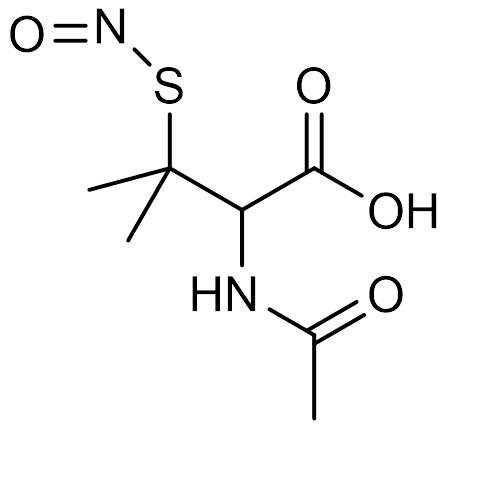
Chemical structure of SNAP (SIH-650), a Nitric Oxide Donor. CAS #: 79032-48-7. Molecular Formula: C7H12N2O4S . Molecular Weight: 220.2 g/mol.
 Powered by Bioz
Reviews
There are no reviews yet.