
Tau Oligomers as Key Drivers of Neuroinflammation
The accumulation of misfolded tau protein is a defining feature of a broad class of neurodegenerative disorders. These disorders are collectively known as tauopathies, including Alzheimer’s disease (AD) and Chronic Traumatic Encephalopathy (CTE). Tau pathology has traditionally been linked to neuronal dysfunction, synaptic loss, and neurodegeneration. However, emerging evidence now shows that the effects of pathological tau, and particularly tau oligomers, are more extensive than previously characterized.
One research area receiving increasing attention is the blood-brain barrier (BBB), a highly specialized vascular interface that separates the central nervous system from the peripheral circulation. The BBB plays a critical role in maintaining brain homeostasis by regulating the movement of nutrients, metabolites, immune cells, and signaling molecules between the blood and neural tissue. Dysfunction of this barrier has emerged as an early and important feature of numerous neurological disorders.
Although previous studies have linked tau pathology to BBB disruption, the molecular mechanisms underlying this relationship remain poorly understood. A recent study by Seplovich et al., published in Microcirculation, provides new insight into how pathological tau may directly compromise BBB integrity. Using human brain microvascular endothelial cells (HBMECs), the authors demonstrate that tau oligomers trigger endothelial barrier dysfunction through activation of the NLRP3 inflammasome pathway, resulting in increased inflammatory signaling and enhanced MMP-9 activity. These findings identify a novel mechanism through which tau pathology may contribute to neurovascular dysfunction during disease progression.
Tau conformational states
Tau is a microtubule-associated protein that plays an essential role in stabilizing the neuronal cytoskeleton. Under pathological conditions, tau undergoes conformational changes that promote aggregation and accumulation within the brain. Throughout disease progression, the protein can adopt multiple structural forms, including monomers, soluble oligomers, and insoluble fibrillar aggregates that ultimately contribute to neurofibrillary tangle (NFT) formation.
For many years, NFTs were considered to be the primary toxic tau species in Alzheimer’s disease. More recently, numerous studies have suggested that soluble tau oligomers may represent the most biologically active and pathogenic form of the protein. Unlike mature fibrils, tau oligomers are highly dynamic and capable of interacting with multiple cellular targets, making them particularly effective drivers of neurotoxicity.
Assessing BBB function with StressMarq’s neurodegenerative tau constructs
To determine whether specific tau species differentially affect BBB function, Seplovich et al. exposed cultured HBMECs to StressMarq’s Tau-441 (2N4R) Wild-Type Oligomers (Baculovirus/Sf9) (catalog# SPR-497) and Tau-441 (2N4R) Wild-Type Pre-formed Fibrils (Baculovirus/Sf9) (catalog# SPR-498). Endothelial barrier integrity and permeability was subsequently measured in vitro using two complementary approaches: FITC-dextran leakage assays and trans-endothelial electrical resistance (TEER).
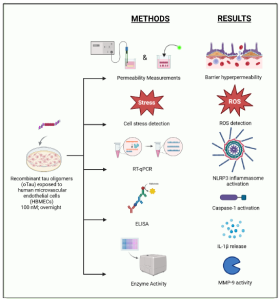
Figure 1. Schematic overview of study methods and results. Human microvascular endothelial cells (HBMECs) were exposed to StressMarq’s Tau-441 (2N4R) Wild-Type Oligomers (Baculovirus/Sf9) (catalog# SPR-497) and employed in subsequent experimentation. Figure taken from Seplovich et al. (2026), and used under license CC BY 4.0.
The collected data revealed that only endothelial monolayers exposed to oligomeric tau exhibited significantly increased permeability, indicative of compromised barrier function. Notably, this effect was observed across multiple oligomer concentrations, suggesting that even relatively low levels of soluble tau oligomers may be sufficient to alter endothelial physiology. In contrast, neither fibrillar nor monomeric tau produced comparable effects under the same experimental conditions. Collectively, these observations add to the growing body of evidence identifying oligomeric tau as a key driver of disease pathology and highlight its potential role in promoting neurovascular dysfunction and BBB impairment in tauopathies.
Barrier dysfunction & inflammasome activation
Increased barrier permeability can often result from direct cellular toxicity, as the loss or detachment of endothelial cells naturally compromises barrier integrity. To determine whether this was responsible for the observed effects, the scientists assessed cell viability, apoptosis, and necrosis following exposure to tau oligomers. Surprisingly, the concentrations of oligomeric tau that induced significant barrier dysfunction did not reduce cell viability or increase markers of cell death. In other words, the endothelial cells remained viable while exhibiting impaired barrier function.
Exposure to tau oligomers also substantially increased reactive oxygen species (ROS) production within endothelial cells. Elevated ROS levels trigger NLRP3 activation and represent a common response to cellular stress. Consistent with inflammasome activation, the researchers observed increased NLRP3 protein levels, elevated caspase-1 activity, and enhanced production of IL-1β following treatment with oligomeric tau. Interestingly, many of these changes occurred without corresponding increases in gene expression, suggesting that tau oligomers primarily influence post-translational signaling events rather than transcriptional regulation.
Taken together, these observations suggest that tau oligomers disrupt BBB integrity through active cellular signaling pathways rather than through irreversible endothelial cell damage. From a therapeutic standpoint, such signaling-driven dysfunction may be more amenable to intervention than widespread cell loss. Furthermore, these results reinforce the growing recognition that tau oligomers can profoundly alter cellular function and physiology without necessarily triggering overt cytotoxicity.
Maintaining endothelial integrity
Researchers repeated key experiments with MCC950 to assess NLRP3 signaling in tau-induced endothelial dysfunction. Inhibition of NLRP3 signaling significantly attenuated many of the pathological effects induced by tau oligomers, including ROS production, inflammasome activation, IL-1β release, MMP-9 activity, and endothelial hyperpermeability. Collectively, these findings provide compelling evidence that NLRP3 activation is a central mediator of tau-induced BBB dysfunction.
Alongside inflammasome activation, the study uncovered a significant increase in matrix metalloproteinase-9 (MMP-9), a proteolytic enzyme known to contribute to BBB disruption through the degradation of extracellular matrix proteins and tight junction components that are essential for maintaining endothelial barrier integrity activity, following exposure to oligomeric tau. Elevated MMP-9 activity has been implicated in a wide range of neurological disorders, including stroke, traumatic brain injury, neuroinflammation, and neurodegenerative disease.
Based on these observations, the researchers propose a mechanistic pathway in which tau oligomers induce oxidative stress, leading to activation of the NLRP3 inflammasome and subsequent production of IL-1β. This inflammatory cascade, in turn, promotes MMP-9 activation, ultimately resulting in endothelial barrier disruption and increased vascular permeability. In tandem, these findings establish a direct molecular link between pathological tau species and BBB dysfunction, while highlighting NLRP3 and MMP-9 as potential therapeutic targets.
Summary
Seplovich et al. identify a novel mechanism linking tau pathology to blood-brain barrier dysfunction. Their experimental design demonstrates that tau oligomers, but not tau monomers or fibrils, induce endothelial hyperpermeability through ROS-dependent activation of the NLRP3 inflammasome and subsequent increases in MMP-9 activity. Importantly, pharmacological inhibition of NLRP3 significantly attenuated these pathological effects, highlighting the inflammasome as a promising therapeutic target for mitigating tau-induced neurovascular dysfunction.
As understanding of the neurovascular contributions to neurodegenerative disease continues to expand, these findings provide valuable insight into how pathological tau disrupts BBB integrity and contributes to disease progression. By identifying a direct molecular link between tau oligomers, inflammasome activation, and endothelial dysfunction, this work broadens the understanding of the mechanisms underlying tauopathy-related vascular impairment. Continued investigation of tau oligomers and NLRP3 signaling may ultimately uncover new therapeutic opportunities to preserve BBB function, reduce neuroinflammation, and slow the progression of Alzheimer’s disease and related tauopathies.
Related StressMarq Products
StressMarq specializes in the production of high-quality, cutting-edge tools for neurodegenerative disease research, with a broad range of tau proteins to meet all research needs. Visit our website for more information, including the latest scientific publications using our specialized tau, amyloid beta, and alpha synuclein and pre-formed fibrils, oligomers, and monomers.
References
- Tau oligomers induce brain endothelial cell hyperpermeability and increase NLRP3 inflammasome signaling and MMP-9 activity. Seplovich, G. et al. Microcirculation. 2026.
Leave a Reply