
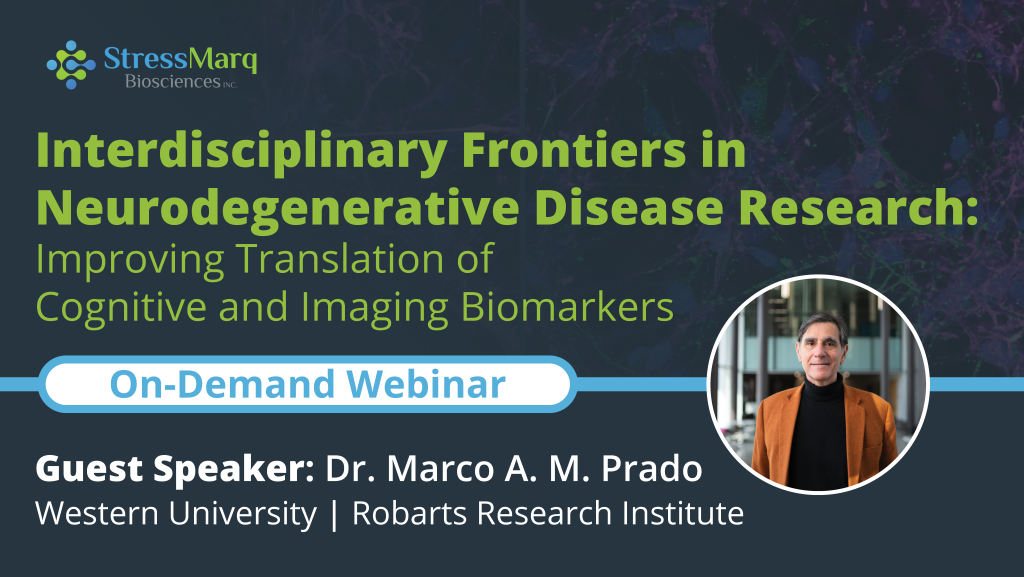
Webinar: Biomarker Translation in Neurodegenerative Disease
Watch On-Demand: Interdisciplinary Translational Platforms to Enhance Neurodegeneration Research
Original Live Broadcast: June 11th, 2026 @ 8 AM PDT | 11 AM EDT | 5 PM CEST
Abstract
Neurodegenerative disorders such as Alzheimer’s disease (AD) and Lewy body dementia remain difficult to understand and treat, in part due to challenges in faithfully replicating the early molecular and synaptic events driving cognitive decline in vivo. While animal models provide a valuable tool to investigate disease mechanisms, many first-generation mouse models—often based on overexpression of human transgenes—fail to reproduce the subtle, region-specific pathology observed in patients.
Next-generation mouse models, incorporating humanized genes and more physiologically relevant risk factors, enable more precise investigation of how neurochemical signaling, protein misfolding, and risk factors contribute to cognitive dysfunction. When combined with translational platforms, including advanced touchscreen-based cognitive testing aligned with human paradigms, and imaging approaches adapted from clinical practice, these models provide a robust framework linking molecular changes to functional outcomes.
In this webinar, we are pleased to welcome Dr. Marco A. M. Prado, Tier 1 Canada Research Chair in Neurochemistry of Dementia at the University of Western Ontario and Scientist at the Robarts Research Institute. A leader in translational neurochemistry, Dr. Prado will discuss integrated experimental platforms to study neurodegeneration across molecular systems and behavioral levels.
Furthermore, he will highlight how genes and neurochemical changes regulate protein misfolding in synucleinopathies, such as Lewy Body dementia, and in Alzheimer’s disease, to impact cognition. Finally, he will also discuss how standardized, automated data collection and open science initiatives such as MouseBytes are improving reproducibility and enabling cross-species comparisons.
StressMarq Biosciences is proud to support this work through ongoing collaborations with global experts. By bringing together scientists and innovators, this webinar aims to foster knowledge exchange and advance therapeutic development for neurodegenerative disease. As the field advances toward mechanism-based therapies, these next-generation models offer a roadmap to improve the predictive power of preclinical research and accelerate translation to clinical outcomes.
Speaker Biography
Dr. Marco A. M. Prado is a distinguished neuroscientist and Tier 1 Canada Research Chair in Neurochemistry of Dementia whose research focuses on how alterations in neurochemical signaling contribute to protein misfolding and dysfunction in disorders such as Alzheimer’s disease and synucleinopathies.

Originally from Brazil, he holds a BPharm from Fluminense University and earned his MSc and PhD in Biochemistry at the Federal University of Minas Gerais. From 1994 to 2008, he served as an Associate Professor in the Department of Pharmacology at the Federal University of Minas Gerais. During this time, his research advanced understanding of neurotransmission and prion diseases, with a continued focus on cholinergic signaling and Alzheimer’s disease. In recognition of his exceptional contributions, he was awarded a Guggenheim Fellowship in Neuroscience in 2004.
In 2008, Dr. Prado joined the University of Western Ontario and the Robarts Research Institute as Professor and Scientist, with joint appointments in the Departments of Anatomy & Cell Biology and Physiology & Pharmacology. Alongside Dr. Vania Prado, he leads a multidisciplinary research program that has developed novel genetically modified mouse models to study mechanisms of cognitive dysfunction, incorporating sophisticated touchscreen-based behavioral testing.
For over 25 years, Dr. Prado served as a reviewer and Deputy Editor-in-Chief for Reviews at the Journal of Neurochemistry. In addition, he has authored more than 200 manuscripts and holds several patents arising from his research. His work has identified neurochemical deficits in dementia and cardiovascular dysfunction, uncovered novel therapeutic targets in prion diseases, and continues to advance translational neuroscience. His research program is currently supported by the Canadian Institutes of Health Research (CIHR), the Alzheimer’s Association (USA), a New Frontiers Transformation grant, The Weston Family Foundation, and the Krembil Foundation.
Learning Objectives
- Evaluate the limitations of first generation transgenic mouse models and explain how next-generation, humanized models improve the study of early molecular pathology in neurodegenerative diseases.
- Understand how neurochemical signaling disruptions and protein misfolding contribute mechanistically to cognitive impairment.
- Identify the value of integrated translational platforms for linking pathological changes to functional cognitive outcomes.
- Assess the impact of standardized, automated data collection and open science initiatives on reproducibility, cross species comparisons, and the predictive validity of preclinical neurodegeneration research.
About StressMarq Biosciences
Established in 2007, StressMarq Biosciences is at the forefront of neurodegenerative disease research, offering specialized fibrillar, oligomeric, and monomeric proteins for alpha synuclein, tau, amyloid beta, TDP-43, SOD1, and TTR. These cutting-edge tools are validated for reproducibility, biological relevance, and experimental consistency, empowering scientists worldwide to accelerate discoveries in Alzheimer’s, Parkinson’s, ALS, MSA, and other neurodegenerative disorders. Visit our website for more information, including the latest scientific publications using our unique tools for neurodegeneration research.
Leave a Reply