
Alzheimer’s Disease: From Discovery to Treatment
Alzheimer’s disease (AD) is a progressive neurodegenerative disease, first described by German psychiatrist Alois Alzheimer in 1906. Since its initial characterization, it has become the most prevalent cause of dementia globally, accounting for approximately 60-80% of all cases. Historically, a definitive diagnosis of Alzheimer’s disease required post-mortem neuropathological examination. However, advances in biomarker technology now allow clinicians to more confidently diagnose Alzheimer’s disease in living patients. Although there is currently no cure for Alzheimer’s disease, recent therapeutic advances have introduced disease-modifying treatments that can modestly slow disease progression in selected patients with early-stage Alzheimer’s disease. However, most available treatments remain focused on managing symptoms rather than reversing established neurodegeneration.
Although aging is the strongest known risk factor for Alzheimer’s disease, the relationship between normal aging and the pathological processes that drive AD remains an area of active investigation. As the number of people impacted by Alzheimer’s and dementia grows, research into prevention, diagnosis and treatment of Alzheimer’s disease becomes increasingly crucial.
Disease Overview
Alzheimer’s disease is classified both as a tauopathy and an amyloidopathy based on the hallmark accumulation of both intracellular tau and extracellular amyloid beta within the brains of patients. Tauopathies are a category of neurodegenerative diseases which are characterized by the abnormal misfolding and accumulation of tau protein within the brain. Though AD is the most common tauopathy, others include Pick’s disease, Frontotemporal dementia, and progressive supranuclear palsy.
As well as the neurofibrillary tangles (NFTs) caused by tau aggregation, another unique hallmark of Alzheimer’s disease is the buildup of amyloid plaques. These amyloid plaques are composed primarily of aggregated amyloid beta peptides that accumulate in the extracellular space surrounding neurons. NFTs and amyloid plaques are associated with neurotoxicity and contribute to structural and functional damage within the brain. Because amyloid beta plaques are often accompanied by other disease-related pathologies, researchers have devoted significant effort to understanding how co-pathologies influence one another and affect the development and progression of Alzheimer’s disease.
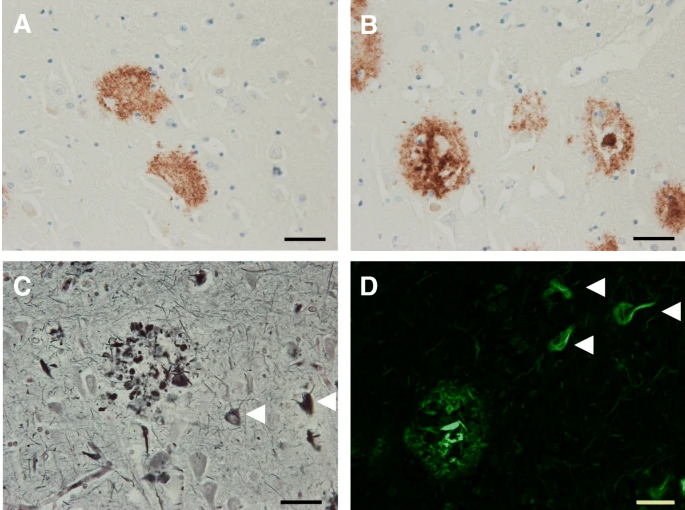
Immunohistochemistry of amyloid plaques in AD-affected tissues. Figure taken from DeTure & Dickson (2019).
Alzheimer’s disease is commonly categorized by age of onset into early-onset Alzheimer’s disease (EOAD), which occurs before age 65, and late-onset Alzheimer’s disease (LOAD), which occurs after age 65. As well as manifesting much earlier, EOAD is often associated with a more rapid rate of cognitive decline. While EOAD is a more aggressive form of the disease, it only accounts for 5-10% of global AD cases, with LOAD making up the remaining 90-95%. While some EOAD cases arise from inherited genetic mutations, many cases occur sporadically without a clear familial cause. Late-onset Alzheimer’s disease is widely believed to result from a complex interaction among aging, genetic susceptibility, and environmental and lifestyle factors, although the specific combination of contributing factors is not always identifiable in individual patients.
Diagnosis
Historically, because a definitive diagnosis required neuropathological confirmation, many patients were clinically diagnosed based on symptoms of dementia rather than the underlying disease pathology. However, advances in biomarker technology now allow clinicians to diagnose Alzheimer’s disease in living patients with increasing confidence using amyloid PET imaging, tau PET imaging, cerebrospinal fluid biomarkers, and emerging blood-based biomarkers. Similar to other neurodegenerative diseases such as Parkinson’s disease, Alzheimer’s disease is characterized by a prolonged preclinical phase, and patients are therefore typically diagnosed only after cognitive symptoms emerge.
Therapeutics
Historically, treatments for Alzheimer’s disease have focused on managing symptoms and generally fall into two categories:
- Cholinesterase inhibitors: These drugs increase acetylcholine levels in the brain to help support memory, learning, and cognitive function. Reduced cholinergic signaling is a hallmark feature of Alzheimer’s disease.
- NMDA receptor antagonists: These drugs regulate the activity of glutamate, a neurotransmitter involved in learning, memory, and synaptic plasticity. Excessive glutamate signaling can contribute to neuronal damage, and these therapies aim to help preserve cognitive function.
Although these treatments can provide symptomatic benefit, they do not address the underlying pathology of Alzheimer’s disease. Furthermore, treatment is often initiated after substantial neurodegeneration has already occurred, limiting its overall effectiveness.
Disease-Modifying Therapies
In recent years, anti-amyloid monoclonal antibodies have emerged as the first disease-modifying therapies for Alzheimer’s disease. Lecanemab, approved by the FDA in 2023, selectively targets amyloid beta protofibrils, while donanemab, approved in 2024, targets established amyloid beta plaques. Both therapies are administered intravenously and have demonstrated modest slowing of cognitive decline in patients with early-stage Alzheimer’s disease, representing an important advance beyond traditional symptomatic treatments. However, both drugs are associated with potential adverse effects, including amyloid-related imaging abnormalities (ARIA), and questions remain regarding their long-term effectiveness, accessibility, and impact on disease progression.
Numerous additional therapeutic approaches are currently under investigation, including therapies targeting tau aggregation, neuroinflammation, synaptic dysfunction, and other mechanisms implicated in Alzheimer’s disease.
Summary
In 2021, the World Health Organization estimated that 57 million people were living with dementia worldwide, with Alzheimer’s disease making up 60-70% of all cases. As the prevalence of Alzheimer’s disease continues to rise, research efforts aimed at elucidating disease mechanisms, improving diagnostic approaches, and developing effective therapies have expanded significantly in recent years.
Related StressMarq Products
StressMarq Biosciences manufactures a diverse range of proteins, antibodies, kits, and small molecules to support Alzheimer’s disease preclinical research. Visit our website to learn more, and to explore the latest scientific publications using our rigorously validated and specialized monomeric, oligomeric, and fibrillar tau, alpha synuclein, amyloid beta, SOD1, TDP-43, and TTR protein preparations.
References
- Alzheimer’s Disease: Treatment Strategies and Their Limitations. Passeri et al., Int. J. Mol. Sci. 2022
- Dementia. 2025
- Early-Onset Alzheimer’s Disease: What Is Missing in Research?. Ayodele et al., Curr Neurol Neurosci Rep. 2021
- How Is Alzheimer’s Disease Diagnosed? 2022
- Safety and efficacy of lecanemab for Alzheimer’s disease: a systematic review and meta-analysis of randomized clinical trials. Qiao et al., Front. Aging Neurosci. 2023
- The history of Alzheimer’s disease. Kiani & Hodson. Nature Milestones. 2024
- The neuropathological diagnosis of Alzheimer’s disease. DeTure & Dickson. Mol Neurodegeneration. 2019.
Leave a Reply