
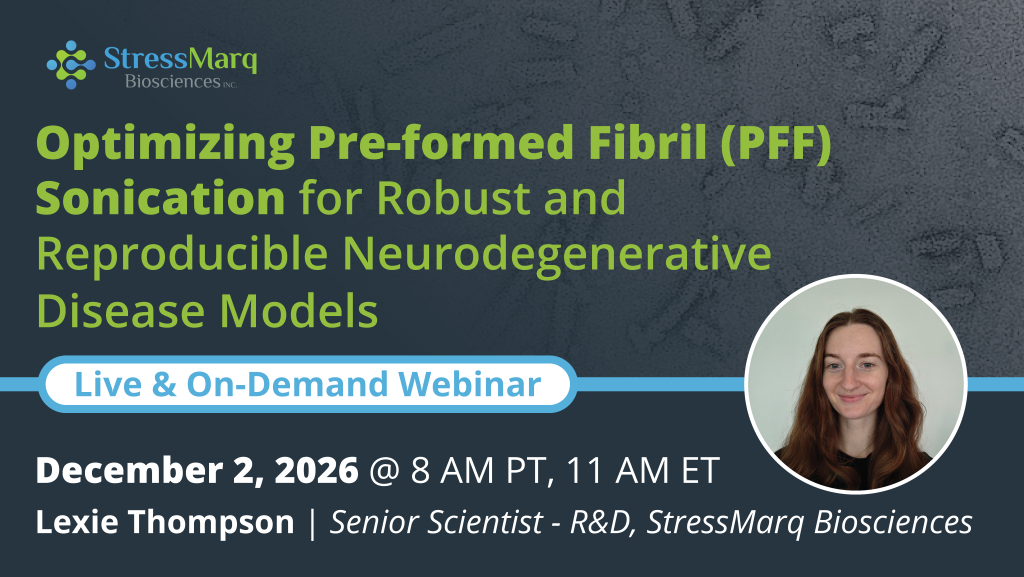
Webinar: Optimizing PFF Sonication for Robust Neurodegenerative Disease Models
Register Now: Optimizing Pre-formed Fibril (PFF) Sonication for Robust and Reproducible Neurodegenerative Disease Models
Live Broadcast: December 2nd, 2026 @ 8 AM PT | 11 AM ET | 5 PM CET
Abstract
Pre-formed fibrils (PFFs) of proteins implicated in neurodegenerative disease—including alpha synuclein, tau, TDP-43, and amyloid beta—are widely employed as experimental tools to model and investigate the cellular and molecular mechanisms underlying neurodegeneration in vitro and in vivo. Protein aggregation is central to the pathology of Parkinson’s disease, Alzheimer’s disease, ALS, and related neurodegenerative disorders, making well-characterized and reproducible commercial PFF preparations critical for robust preclinical research.
Controlled fragmentation via sonication is a key step in preparing PFFs for experimental use. Fibril size can influence cellular uptake, seeding efficiency, and downstream experimental outcomes. Additionally, PFFs are highly sensitive to sonication conditions, and differences in sample handling, sonication parameters, and instrumentation can increase variability.
In this webinar, StressMarq Biosciences will provide a practical overview of PFF sonication. Topics will include sample preparation, sonication methods, temperature control, and instrument-specific factors. We will discuss best practices for maintaining consistent conditions and developing reproducible protocols based on validated experimental parameters rather than nominal instrument settings alone. Practical strategies for troubleshooting and validating sonication conditions will be described, with an emphasis on how consistent PFF preparations from commercial suppliers can support reliable downstream studies of protein aggregation and seeding in neurodegenerative disease models.
The session will also explore dynamic light scattering (DLS) for the assessment of particle size distributions following sonication. Together, these topics will provide researchers with a practical framework for optimizing and monitoring PFF sonication to improve consistency and reproducibility in downstream studies of protein aggregation and function.
Speaker Biography
Lexie Thompson joined StressMarq Biosciences as a Scientist in Custom Development & Manufacturing in 2023 and currently serves as a Senior Scientist in Research & Development.

In this role, she applies her expertise in protein structure, stability, and function to the development and characterization of novel and custom protein preparations for preclinical neurodegenerative disease research. Her work focuses on the production of oligomeric, fibrillar, and monomeric protein preparations for key proteins involved in neurodegeneration, including alpha synuclein, tau, TDP-43, and amyloid beta. Through this work, she supports the development of research tools and protein-based reagents for investigators worldwide studying protein misfolding, aggregation, and other molecular mechanisms underlying neurodegenerative disease.
As a trained biochemist, Lexie holds a BSc in Biochemistry & Chemistry and an MSc in Biochemistry from the University of Victoria in Victoria, BC, Canada. During her graduate studies, she conducted research under the supervision of Dr. Martin Boulanger, Canada Research Chair in Molecular Interactions and Structural Biology, and Dr. Caroline Cameron, Canada Research Chair in Molecular Pathogenesis. Her MSc research focused on the Treponema pallidum surface protein Tp0751 and its application as a chimeric protein scaffold for the development of a recombinant vaccine candidate. This investigation involved the iterative design and engineering of Tp0751-based vaccine constructs, with a focus on optimizing protein stability and suitability as a recombinant vaccine platform.
Learning Objectives
- Identify the key experimental variables that influence PFF sonication and fragmentation.
- Apply best practices for optimizing and troubleshooting PFF sonication protocols to improve consistency and reproducibility between preparations.
- Evaluate the use of dynamic light scattering (DLS) for PFF characterization, including its strengths and limitations for assessing particle size distributions and monitoring consistency following sonication.
About StressMarq Biosciences
Established in 2007, StressMarq Biosciences is at the forefront of neurodegenerative disease research, offering specialized fibrillar, oligomeric, and monomeric proteins for alpha synuclein, tau, amyloid beta, TDP-43, SOD1, and TTR. These cutting-edge tools are validated for reproducibility, biological relevance, and experimental consistency, empowering scientists worldwide to accelerate discoveries in Alzheimer’s, Parkinson’s, ALS, MSA, and other neurodegenerative disorders. Visit our website for more information, including the latest scientific publications using our unique tools for neurodegeneration research.
Leave a Reply