

Emerging Antibody Strategies in Tau Immunotherapy for Alzheimer’s Disease
Alzheimer’s disease (AD) is the most common cause of dementia worldwide, yet effective treatments and antibody-based therapies remain limited. Like other tauopathies, AD is characterized by the hyperphosphorylation, pathological misfolding, and aggregation of tau proteins into neurofibrillary tangles (NFTs) that progressively spread throughout the brain. This propagation of pathological tau, known as seeding, is thought to contribute to the progressive cognitive impairment observed in several neurodegenerative diseases.
Recent clinical progress with anti-tau immunotherapies has provided evidence that targeting tau may help slow disease progression. These second-generation therapeutic monoclonal antibodies target epitopes within or near the microtubule-binding region (MTBR) of tau and include Etalanetug and Bepranemab. However, current immunotherapies often require high doses and may possess limited ability to recognize the diverse range of pathological tau species present in patients’ brains.
To address these limitations, Light Chain Bioscience (Switzerland), Vrije Universiteit Amsterdam (the Netherlands), and StressMarq Biosciences (Canada) have collaborated to develop a novel third-generation biparatopic anti-tau antibody. In an emerging study published in Alzheimer’s Research & Therapy, Hatterer et al. designed NIDB-3101 to simultaneously bind two distinct tau epitopes, with the goal of increasing affinity for pathological tau while broadening target coverage. The researchers also incorporated half-life extension technology, potentially enabling less frequent dosing and reducing overall dosing requirements.
Target identification using StressMarq’s neurodegenerative proteins
Using phage display technology, scientists generated and characterized antibodies targeting three distinct regions of tau: the N-terminal region (amino acids 1-8), the R4 microtubule-binding region (amino acids 344-349), and the C-terminal domain (amino acids 426-430). Following selection of antibodies with the strongest binding to recombinant tau, Hatterer et al. evaluated their specificity for commercially-available pre-formed fibrils (PFFs) using an enzyme-linked immunosorbent assay (ELISA). StressMarq’s Tau-441 (2N4R) P301S Mutant Pre-formed Fibrils (catalog# SPR-329) and Alpha Synuclein Pre-formed Fibrils (Type 1) (catalog# SPR-322) were immobilized on 96-well plates and probed with the candidate antibodies. Although all three antibodies bound specifically to recombinant tau, functional testing revealed remarkable differences in their ability to inhibit pathological tau propagation.
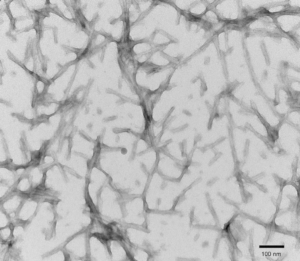
Figure 1. [Image from: StressMarq website]. Representative negative stain TEM image of StressMarq’s Tau-441 (2N4R) P301S Mutant PFFs (catalog# SPR-329).
Creation of biparatopic antibody NIDB-3101
Having identified two functionally effective tau-targeting antibodies, the authors subsequently combined them to create a single biparatopic antibody, NIDB-3101, capable of simultaneously recognizing the R4 microtubule-binding region and the C-terminal domain of tau. Alzheimer’s disease pathology is characterized by a diverse population of pathological tau species, including truncated, post-translationally modified, and aggregated forms. By targeting two distinct epitopes, NIDB-3101 may therefore recognize a broader range of pathological tau species and conformations than conventional monospecific antibodies. Detailed epitope mapping confirmed that NIDB-3101 retained binding to both target regions, while structural studies further validated the molecular interactions between the antibody and each tau epitope.
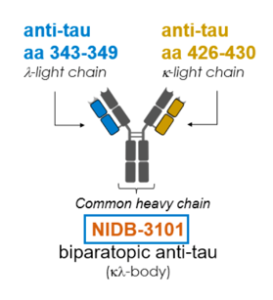
Figure 2. Biparatopic binding domains within the tau 2N4R protein visualized with epitope locations determined by overlapping binding peptides. Figure taken from Hatterer et al., 2026 used under license CC BY 4.0.
Recognition of truncated and aggregated tau
One of the study’s key findings was the ability of NIDB-3101 to recognize a broad range of pathological tau species. When tested against a panel of truncated tau constructs, NIDB-3101 demonstrated robust recognition across all species examined, whereas the parental monospecific antibodies showed more limited recognition. Notably, NIDB-3101 also recognized aggregated truncated tau species that closely resemble the pathological tau structures identified in AD brain tissue by cryo-electron microscopy.
NIDB-3101 also bound strongly to StressMarq’s Tau-441 (2N4R) P301S Mutant Pre-formed Fibrils (Baculovirus/Sf9) (catalog# SPR-471), hyperphosphorylated tau fibrils capable of replicating the post-translational modifications commonly observed in Alzheimer’s disease states. Binding signals were higher than those observed with either parental antibody alone, supporting the potential advantage of simultaneous engagement of two distinct tau epitopes. Functionally, NIDB-3101 produced significantly greater inhibition of tau aggregation in cell-based assays than either parental antibody individually. The single biparatopic antibody achieved an effect comparable to that observed when both parental antibodies were administered together.
Antibody binding affinity
The researchers next compared NIDB-3101 with three clinically relevant second-generation anti-tau antibody analogues: Bepranemab, BMS-986446, and Etalanetug. Surface plasmon resonance (SPR) measurements revealed that NIDB-3101 had exceptionally high affinity for StressMarq’s Tau-441 (2N4R) Wild-Type Monomers (catalog# SPR-479), with an apparent dissociation constant of approximately 0.035 nM. This affinity was substantially higher than that measured for the Bepranemab, Etalanetug, and BMS-986446 analogues. Additional ELISA analysis confirmed that NIDB-3101 exhibited higher maximal binding and approximately 10-fold lower EC50 values than all three benchmark antibodies, indicating greater apparent potency and stronger recognition of tau fibrils.
When evaluated using postmortem brain tissue homogenates from patients with Alzheimer’s disease, NIDB-3101 demonstrated significantly stronger binding in dot blot assays than both the BMS-986446 analogue and the parental antibodies, while exhibiting minimal reactivity toward control brain samples. Western blot (WB) analysis further indicated that NIDB-3101 recognized a broad spectrum of pathological tau species spanning multiple molecular weights, with particularly strong reactivity in insoluble fractions enriched for aggregated tau. The antibody also displayed high specificity, with no detectable binding to irrelevant proteins or unrelated human cell lines.
Immunohistochemical analysis provided additional evidence of its broad pathological tau recognition. NIDB-3101 robustly labeled the hallmark tau lesions observed in AD, including neurofibrillary tangles, ghost tangles, neuropil threads, dystrophic neurites, coiled bodies, and granular neuronal inclusions. Collectively, these findings demonstrate that NIDB-3101 recognizes a diverse array of pathological tau species and neuropathological structures that accumulate in the brains of patients with Alzheimer’s disease.
Half-life and specificity
Beyond improving tau recognition, Hatterer et al. engineered NIDB-3101 to incorporate properties intended to support its therapeutic development. Two sets of Fc modifications were introduced: LALA mutations to reduce Fcγ receptor binding and potentially minimize Fc-mediated inflammatory effects, and YTE mutations to enhance binding to the neonatal Fc receptor (FcRn), thereby promoting antibody recycling and extending systemic half-life. Experimental studies confirmed the intended effects of both modifications. The LALA mutations substantially reduced Fcγ receptor interactions, while the YTE mutations increased FcRn binding by approximately 14.5-fold under acidic conditions relevant to FcRn-mediated recycling. Cellular recycling assays further demonstrated significantly improved recycling efficiency for the YTE-containing antibody variant. Importantly, these Fc modifications did not compromise the antibody’s ability to inhibit tau aggregation.
Some of the most compelling findings came from experiments using tau fibrils directly isolated from Alzheimer’s disease brain tissue. Immunogold electron microscopy allowed researchers to conclude that NIDB-3101 bound more extensively to Alzheimer’s disease-derived paired helical filaments than the second-generation anti-tau antibody analogues. In tau biosensor cells seeded with brain-derived tau, NIDB-3101 reduced intracellular tau aggregation by approximately 70–80%, compared with more modest reductions of approximately 11–33% for the comparator antibodies. These findings demonstrate that the enhanced tau recognition of NIDB-3101 is accompanied by increased functional activity against disease-associated tau seeds derived directly from AD brain tissue.
Summary
In this study, the investigators comprehensively characterized the biparatopic antibody NIDB-3101 and compared it with several clinically relevant second-generation anti-tau antibody analogues. Hatterer et al. demonstrated that NIDB-3101 exhibits high binding affinity and broad recognition of both recombinant tau and pathological tau species derived from Alzheimer’s disease brain tissue, with greater activity than the comparator antibodies across several assays. Fc engineering successfully enhanced FcRn-mediated recycling and extended the antibody’s functional half-life while reducing Fcγ receptor interactions. Collectively, these findings support NIDB-3101 as a promising next-generation tau-targeting therapeutic candidate and provide a rationale for further investigation of its potential in the treatment of Alzheimer’s disease and related neurodegenerative disorders.
Related StressMarq products
StressMarq manufactures a wide range of neurodegenerative proteins in different conformations, providing researchers with high-quality tools designed to support experimental reproducibility and biological relevance in models of protein misfolding, aggregation, and prion-like propagation. Visit our website for more information, including the latest scientific publications using our specialized tau, amyloid beta and alpha synuclein proteins for neurodegenerative disease research. Of particular relevance are the Tau dGAE (297-391) AD-mimic Pre-formed Fibrils (catalog# SPR-502), which replicate the characteristic filament fold observed in Alzheimer’s disease-derived tau aggregates. This model system provides a structurally relevant tool for studying aggregation and seeding mechanisms associated with MTBR/R′-containing tau species.
References
- A third-generation, high-affinity biparatopic anti-tau antibody inhibits intracellular tau aggregation seeded by Alzheimer’s brain extracts. Hatterer, E. et al. Alz Res Therapy. 2026.
Leave a Reply