
Alpha Synuclein Type 1 and Type 2: What’s the Difference?
Overview
StressMarq’s Type 1 (SPR-321) and Type 2 (SPR-316) Human Alpha Synuclein Monomers are closely related protein preparations primarily used in alpha synuclein aggregation, seeding, and pathology studies. Understanding the differences between Alpha Synuclein Type 1 and Type 2 is important when selecting reagents for various research applications.
Type 1 monomers are used to generate Human Alpha Synuclein Type 1 Pre-formed Fibrils (PFFs) (SPR-322), while Type 2 monomers are used to generate Human Alpha Synuclein Type 2 Pre-formed Fibrils (PFFs) (SPR-317).
The two monomeric proteins are nearly identical in amino acid sequence, differing only by an additional N-terminal methionine residue in Type 2. They are also produced using different expression and purification conditions. Both preparations are low endotoxin (<5 EU/mL); however, Type 2 monomers undergo an additional weak cation-exchange chromatography purification step.
Key Differences Between Type 1 and Type 2
The additional purification step appears to contribute to differences in the structural and functional properties of the resulting pre-formed fibrils. PFFs generated from Type 1 and Type 2 monomer preparations differ in β-sheet content and secondary structural characteristics. As a result, the corresponding PFFs exhibit different functional properties, including differences in seeding activity and phosphorylated Ser129 (pSer129) pathology.
In seeded Thioflavin T (ThT) assays, Type 1 PFFs (SPR-322) demonstrate robust seeding activity, producing strong ThT fluorescence signals. Type 1 PFFs have also been shown to generate pSer129 alpha synuclein pathology in both in vitro and in vivo models.
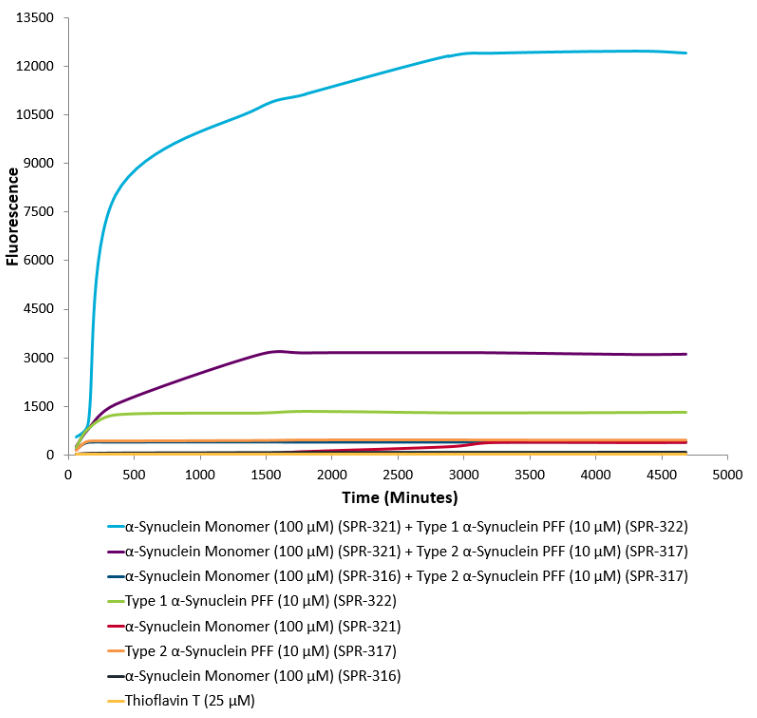
Figure 1. Seeded Thioflavin T (ThT) aggregation assay comparing Type 1 (SPR-321) and Type 2 (SPR-316) alpha synuclein monomers. Type 1 monomers seeded with Type 1 PFFs (SPR-322) generate substantially stronger ThT fluorescence than Type 2 monomers under comparable conditions, consistent with enhanced fibril formation and seeding activity.
By comparison, Type 2 monomers exhibit substantially lower fibril formation and correspondingly weaker ThT fluorescence than Type 1 monomers under comparable seeding conditions, in some cases by up to an order of magnitude. Type 2 PFFs also exhibit distinct secondary structural characteristics compared with Type 1 PFFs.
Although Type 2 PFFs are capable of inducing cellular toxicity, preliminary data suggest that pathology develops more slowly than with Type 1 PFFs and may therefore require longer experimental time frames to detect.
Choosing the Right Product for Your Research
Researchers seeking rapid fibril formation, strong Thioflavin T (ThT) signal generation, or robust seeding activity over shorter experimental time frames will generally find Type 1 PFFs (SPR-322) to be the more suitable choice. In contrast, Type 2 monomers (SPR-316) may be better suited for Seed Amplification Assays (SAA) and Real-Time Quaking-Induced Conversion (RT-QuIC), where reduced spontaneous aggregation is often desirable while maintaining sensitivity to seeded aggregation.
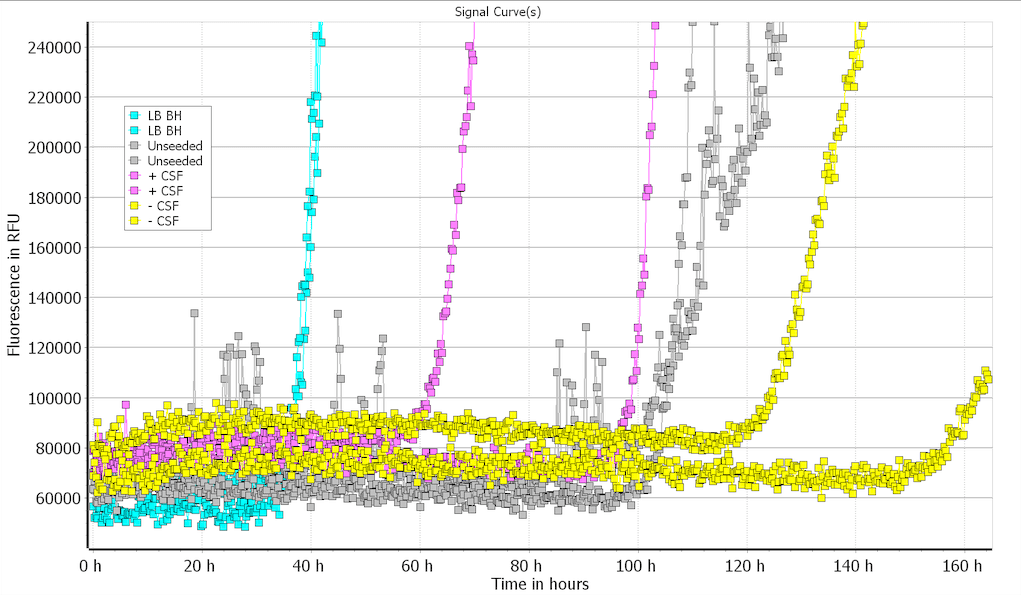
Figure 2. Preliminary RT-QuIC data using Type 2 alpha synuclein monomers (SPR-316) as the reaction substrate. Positive cerebrospinal fluid (CSF) samples produce earlier signal amplification than negative and unseeded controls, demonstrating the suitability of Type 2 monomers for seed amplification workflows.
Summary
StressMarq’s Type 1 and Type 2 Human Alpha Synuclein Monomers and PFFs are suitable for a wide range of in vitro and in vivo research applications, including aggregation studies, fibril generation, Western blotting, and SDS-PAGE analysis. For applications requiring efficient PFF generation and strong seeding performance, Type 1 monomers and PFFs remain the preferred choice.
- Aggregation and seeding: Type 1 generates fibrils more readily and produces significantly stronger ThT signals than Type 2.
- Distinct fibril structures: Type 1 and Type 2 produce PFFs with different β-sheet content and secondary structural characteristics, resulting in different functional properties.
- Optimized for different applications: Type 1 is best for robust PFF generation and pathology studies, while Type 2 is better suited for SAA and RT-QuIC workflows where reduced spontaneous aggregation is preferred.
Resources
For assistance selecting the most appropriate alpha synuclein construct for your research, please contact Technical Support.
Additional resources are available on the Alpha Synuclein products page and the Alpha Synuclein FAQs. To explore published studies using StressMarq’s alpha synuclein products, please visit the Product Citation Hub.
Leave a Reply